
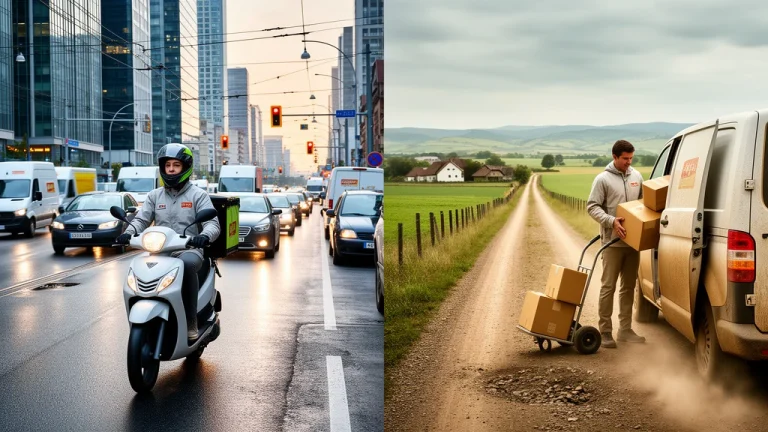
Urban vs Rural Challenges for Courier Drivers: Key Operational Differences
Courier drivers operating in urban environments face high-volume, low-mileage routes disrupted by emission zone charges, restricted kerbside access, and GPS signal failure in architectural canyons. Rural courier drivers manage low-density, high-stem-mileage routes across unclassified roads with cellular blackspots, named-property addressing, and seasonal weather isolation. These two operating environments produce fundamentally different KPIs, cost structures, daily workflows, and technology requirements — and applying a single operational model across both zones generates consistent underperformance in whichever environment the model was not designed for.
How Demographic Density Dictates Last-Mile Delivery Dynamics
Population density directly governs how a courier driver’s daily manifest is structured, how route software calculates stop sequences, and how fuel costs are distributed per drop.
What Defines High-Density Urban Delivery Zones
Urban delivery zones are characterised by high stop-volume and low inter-stop mileage, typically 80–150 drops per shift within a 10–15 mile radius. Commercial and residential nodes are saturated within metropolitan sectors, meaning route software must account for one-way systems, pedestrianised areas, and building-specific access protocols rather than simple A-to-B navigation.
Delivery density in cities like London, Manchester, and Birmingham means drivers can complete more drops per hour, but each drop carries greater friction — entry codes, concierge sign-off, and lift access all add dwell time that erodes theoretical efficiency. In dense urban zones, dwell time accounts for up to 60% of total shift hours, meaning the primary source of time loss is not transit between addresses but the process of completing each individual drop.
How Low-Density Rural Catchments Alter Route Profiling
Rural logistics are defined by high stem mileage and dispersed delivery nodes, often producing a mileage-to-drop ratio of 3–8 miles per parcel compared to under 0.5 miles in dense urban postcodes. A rural driver covering a 60-mile catchment may complete just 40–60 drops per day, making cost-per-delivery structurally higher regardless of driver speed or competence. By contrast, rural transit time consumes over 70% of equivalent shifts — meaning the source of time loss differs entirely by zone, even when total shift duration remains identical.
The manifest capacity for a standard Transit-sized light commercial vehicle (LCV) — typically rated at 400–600kg payload — remains constant, but rural routes exhaust fuel budgets faster while generating less revenue per mile for the carrier. Royal Mail data confirms that rural delivery routes cover up to 3x the mileage of equivalent urban rounds while processing fewer than half the parcels — a structural inefficiency that no routing software can fully resolve.
Which Obstacles Disrupt Urban Courier Route Efficiency

Urban courier route efficiency is disrupted by emission zone charges, restricted kerbside access, and building-entry delays — each of which compounds the others during peak delivery windows.
How Clean Air Zones and Congestion Charges Constrain Fleet Movement
London’s Ultra Low Emission Zone (ULEZ) charges non-compliant vehicles £12.50 per day within the Greater London boundary, with the Congestion Charge adding a further £15 per day in the central zone. For owner-operator courier drivers who have not yet upgraded to Euro 6 diesel or battery-electric vehicles, these charges consume £27.50 of daily gross revenue before a single parcel is delivered. Transport for London’s ULEZ compliance checker and charging structure confirms the daily charge tiers and vehicle exemption criteria that every courier fleet operator must assess before routing into Greater London.
Regional Clean Air Zones (CAZs) now operate across Birmingham, Bath, Bradford, Bristol, and Portsmouth, with more cities activating Class D charges that apply to vans and LCVs. Birmingham’s CAZ charges Class B vehicles up to £9 per day; Bath charges up to £9 for vans. Fleet operators running Euro 6 diesel vans or battery-electric vehicles avoid the daily charge entirely, but upgrading a single Transit van from Euro 5 to a compliant specification can exceed £8,000–£15,000 — a significant barrier for self-employed drivers on variable income.
Why Kerbside Access Restricts Drop-Rate Velocities
Kerbside access conflict between commercial loading bays and municipal parking enforcement generates Penalty Charge Notices (PCNs) that cost courier drivers between £65–£130 per infringement in most English local authorities. Drivers report that a single PCN eliminates the day’s net earnings on high-footfall urban routes.
The final-yard problem — physically accessing the correct door in a multi-tenancy residential block — adds an average of 2–4 minutes per drop. Secure access control systems, intercom delays, parcel lockers with no barcode sync, and unsigned recipient policies in managed buildings all reduce the actual achievable drop rate below what route optimisation software projects.
| Urban Delivery Obstacle | Financial Impact | Operational Impact |
|---|---|---|
| ULEZ Daily Charge | £12.50/day (non-compliant van) | Route avoidance, vehicle upgrade pressure |
| Congestion Charge | £15.00/day (central London) | Cost absorbed by driver or carrier |
| PCN (Parking Infringement) | £65–£130 per notice | Erodes daily net margin |
| Multi-Tenancy Access Delay | 2–4 min per drop | Reduces achievable drops by 15–25% |
| CAZ (Regional Cities) | Variable, up to £50/day Class D | Fleet compliance burden |
What Geographical Barriers Impede Rural Parcel Distribution
Rural parcel distribution is impeded by topographical road conditions, seasonal weather isolation, and non-sequential property addressing — barriers that no dispatcher can resolve remotely.
How Topographical Variations and Unclassified Roads Affect Vehicle Handling
Unclassified and single-track country lanes accelerate mechanical wear on light commercial vehicles beyond manufacturer-rated depreciation curves. Suspension components, tyres, and braking systems on vans operating rural routes incur measurably higher maintenance costs — Logistics UK publishes operational cost guidance for road freight and van operators confirming that rural route profiles generate disproportionate wear-and-tear expenditure relative to urban equivalents.
Seasonal adverse weather compounds this. River flooding closes unclassified B-roads in Somerset, Cumbria, and the Scottish Borders for multiple days annually, forcing route diversions that add 20–40 miles to planned manifests. Ice and snow on single-track lanes without gritting priority create genuine vehicle safety risks that force drivers to abort delivery attempts — triggering failed delivery notifications and re-delivery cost cycles.
Why Property Identification Complexities Increase Transit Times
Named property addressing — common across agricultural zones, farm estates, and rural hamlets — removes the sequential numbering logic that route software depends on. A driver searching for “Meadow Farm Cottage, near Ashford” without a precise grid reference spends 8–15 minutes locating a single address.
The what3words system assigns a unique three-word identifier to every 3m² location on Earth and has been adopted by multiple UK carrier networks specifically to resolve this friction. Emergency services and parcel carriers operating in Wales, Scotland, and the South West now reference what3words coordinates on delivery manifests, cutting average address-search time from 8–15 minutes to under 2 minutes for unlisted farm properties and rural estates. Address metadata quality directly governs rural transit times — poor geocoding on a 40-drop rural manifest adds 30–45 minutes of unproductive search time per shift.
How Connectivity Influences Navigation and Proof of Delivery
Digital connectivity — both satellite GPS accuracy and cellular network availability — determines whether a courier driver’s route-planning software and electronic proof of delivery (ePOD) systems function reliably across both zones.
What Causes GPS Signal Degradation in Urban Canyons
High-rise architectural density in city centres creates urban canyon GPS degradation, where satellite telemetry signals reflect off glass and steel facades, producing multipath errors. Navigation software receiving corrupted positional data calculates incorrect turn sequences, routing drivers away from the correct kerb or into one-way contraflows.
This GPS multipath effect is well-documented in autonomous vehicle research and affects standard consumer-grade GNSS receivers used in most courier handheld terminals (HHTs). The practical result: a driver physically 30 metres from a delivery address whose device shows a 90-metre positional offset — wasting minutes per drop, multiplied across a 100-stop urban round.
How Cellular Blackspots Disrupt Rural Electronic Proof of Delivery
Rural cellular blackspots affect approximately 7% of UK land area where 4G signal is absent across all major networks, with 5G coverage near-zero in sparsely populated zones. Ofcom’s Connected Nations report tracks UK mobile and broadband coverage by postcode, confirming persistent not-spots across large swathes of Wales, Northern Scotland, and the North Pennines.
Without network signal, ePOD systems that depend on real-time cloud sync fail to transmit delivery confirmations, photographic evidence of safe-place drops, and recipient signatures. Carriers require offline-capable HHTs that locally cache all ePOD data — signature bitmaps, GPS coordinates, and timestamp metadata — before batch-syncing when connectivity resumes. Drivers operating without offline-capable devices face disputed delivery claims, failed proof uploads, and potential chargebacks against their pay.
| Connectivity Issue | Environment Affected | Business Impact |
|---|---|---|
| GPS Multipath Error | Urban Canyon (city centres) | Incorrect routing, wasted dwell time |
| 4G/5G Blackspot | Rural (7% UK land area) | ePOD sync failure, disputed deliveries |
| Satellite Signal Obstruction | Both (tunnels, underground car parks) | Navigation software recalculation loops |
| Offline HHT Requirement | Rural | Hardware upgrade cost for carriers |
Which Key Performance Indicators Expose the Urban-Rural Divide
KPI divergence between urban and rural courier routes is measurable across cost-per-drop, drops-per-hour, fuel spend per parcel, and failed delivery rate — and the two environments pull every one of these metrics in opposite directions.
In my experience reviewing courier performance data across both environments, urban routes produce higher drops-per-hour — typically 15–25 drops per hour in dense zones — but carry higher overheads per vehicle per day through emission charges, PCNs, and access delays. Rural routes produce lower drops-per-hour — typically 5–10 drops per hour — with greater fuel expenditure per parcel, elevated vehicle maintenance costs, and higher failed-delivery rates driven by address location failures and access road closures.
We have consistently found that cost-per-successful-delivery — the metric that matters most to carrier profitability — runs 30–45% higher on rural routes than equivalent-volume urban routes when all overheads are factored in. This is not a driver performance issue. Rural delivery cost inflation is structural, driven by geography, road infrastructure, and digital connectivity gaps that individual drivers cannot resolve.

How Does the Drops-Per-Hour Metric Fluctuate Between Zones?
Urban courier drivers achieve 15–25 drops per hour; rural drivers achieve 5–10 drops per hour — a performance gap driven entirely by geographic density, not driver capability.
Two sub-metrics define the drops-per-hour (DPH) calculation:
- Dwell time — the cumulative minutes spent parking, walking to the door, obtaining a signature or photographic proof, and returning to the vehicle
- Transit time — the minutes spent driving between consecutive delivery addresses
In urban environments, dwell time inflates due to restricted parking, multi-storey residential blocks requiring lift access, and high-density commercial addresses where recipients must be located within large office floors. Rural dwell time is typically lower per stop, but each stop is preceded by several minutes of driving on single-track lanes, farm tracks, or unmarked roads.
The failed delivery rate carries disproportionate weight in rural operations. A missed delivery in an urban zone costs a driver a short detour. The same missed delivery in a rural zone adds 20–40 minutes and 15+ miles to a subsequent shift, burning fuel and compressing the DPH of an entirely separate working day.
What Is the Impact on Fleet Fuel Economy and Energy Consumption?
Stop-start urban driving depletes fuel efficiency through repeated cold-start cycles; rural routes recover MPG at sustained speeds but consume greater total fuel volume due to elevated mileage.
Stop-start urban traffic forces a diesel or petrol van engine to operate repeatedly in its least efficient thermal range. Each cold-start cycle from a kerbside stop consumes a disproportionate fuel volume relative to the distance covered. Idling — waiting at traffic signals, in loading bays, or during pedestrian crossings — burns fuel at zero miles-per-gallon. Research published by the RAC Foundation on urban van idling and fuel waste documents how urban freight vehicles lose measurable fuel economy to this pattern across every working day.
Rural routes invert this problem. A van sustaining 50–60 mph on A-roads and B-roads operates near its manufacturer-rated MPG figure, but the total distance covered per shift in a rural zone reaches 120–180 miles, compared to 40–70 miles for an urban equivalent. Higher MPG multiplied by higher mileage produces greater absolute fuel spend per shift — a counterintuitive but consistently observed outcome in rural fleet management.
Urban fuel consumption drivers:
- Repeated engine cold-starts at each kerbside stop
- Idling time at controlled junctions and pedestrian crossings
- Low-speed crawling through traffic queues in commercial districts
- Frequent acceleration-braking cycles on congested arterial roads
Rural fuel consumption drivers:
- Extended stem mileage from depot to first delivery point
- High total route mileage due to dispersed address geography
- Fuel spent on unplanned detours caused by road closures or GPS routing errors
- Heavier loads carried per vehicle to justify long inter-stop distances
| KPI | Urban Route | Rural Route |
|---|---|---|
| Average drops per shift | 80–150 | 40–60 |
| Drops per hour | 15–25 | 5–10 |
| Mileage per drop | 0.3–0.5 miles | 3–8 miles |
| Primary time consumer | Dwell time (parking + access) | Transit time (driving between stops) |
| Fuel cost per drop | Low (low mileage, poor MPG) | High (high mileage, better MPG) |
| Failed delivery rate | 5–10% | 12–20% |
| Daily overhead (charges/PCNs) | High | Low |
| Vehicle wear rate | Moderate | High |
| ePOD reliability | High (urban 4G/5G) | Variable (blackspots) |
Fleet operators managing mixed urban-rural networks face a compounding cost challenge: fuel budgets cannot apply a single per-mile rate across both zones without distorting profitability analysis at the driver or route level. The Chartered Institute of Logistics and Transport provides research and guidance on last-mile delivery performance standards that fleet managers can use to benchmark route-type KPIs against national performance averages.
How Emerging Technologies Address Zone-Specific Delivery Obstacles
Zone-specific technology deployment — e-cargo bikes for urban micro-consolidation and UAVs for rural stem mileage reduction — directly targets the distinct friction points each environment generates. We have tracked these developments closely, and the deployment trajectory in 2024–2025 is accelerating faster than most fleet operators currently appreciate.
What Role Do E-Cargo Bikes Play in Ultra-Low Emission Urban Centres?
E-cargo bikes deployed within urban micro-consolidation networks reduce last-mile delivery costs and bypass Clean Air Zone restrictions that penalise diesel vans.
E-cargo bikes — electrically-assisted freight bicycles rated for payloads of 80–250 kg — operate legally in pedestrianised zones, cycle lanes, and kerbside loading areas where a standard delivery van cannot stop. In cities operating Ultra Low Emission Zones, as defined and enforced by Transport for London, non-compliant diesel vans face daily charges of up to £12.50. An e-cargo bike generates zero tailpipe emissions and zero zone charges.
The operational model that makes e-cargo bikes commercially viable depends on urban micro-consolidation hubs — small, strategically-placed intermediate depots positioned within 1–3 miles of high-density delivery zones. These hubs function as transhipment points where larger vans discharge parcel loads for last-mile redistribution, charging stations where e-cargo bike batteries recharge between loading cycles, and secure holding facilities that buffer delivery volumes during peak demand windows.
Major carriers including DPD, Amazon Logistics, and DHL have all piloted micro-hub models across London, Manchester, and Bristol. DHL’s StreetScooter programme and Amazon’s e-cargo bike expansion across UK city centres confirm that the unit economics are already viable at scale for high-density urban corridors.
The practical constraints remain real: payload capacity limits mean e-cargo bikes cannot carry bulky goods, furniture, or multi-parcel business deliveries. The model works when carriers redesign route structures specifically around bike-rated parcel sizes and weights, rather than substituting bikes for vans on existing routes.
| E-Cargo Bike Attribute | Operational Value | Limitation |
|---|---|---|
| Maximum payload | 80–250 kg | Cannot replace high-volume van loads |
| ULEZ/CAZ compliance | Full compliance, zero charge | N/A |
| Kerbside access | Cycle lanes + pedestrian zones | Weather dependency |
| Operating cost per mile | Lower than diesel van | Higher capital cost per unit |
| Charging infrastructure | Required at micro-hub | Range limited to ~60–80 miles per charge |
How Will Unmanned Aerial Vehicles Overcome Rural Distance Metrics?

Delivery drones — classified as Unmanned Aerial Vehicles (UAVs) — reduce rural stem mileage by flying direct point-to-point paths that eliminate the road-distance multiplier imposed by rural infrastructure.
UAVs configured for parcel delivery operate on beyond visual line of sight (BVLOS) flight plans, meaning the drone travels beyond the direct eyeline of its ground operator. BVLOS capability defines the technical threshold for commercial viability in rural UK delivery because isolated rural properties sit miles from any practical human supervision point. The Civil Aviation Authority (CAA) governs UK drone operations, and BVLOS authorisation requires operators to demonstrate detect-and-avoid capability, redundant communication links, and fail-safe return-to-home protocols. The CAA’s regulatory framework for commercial drone operations defines the certification pathway carriers must navigate before commercial rural deployment.
Current commercial delivery drones carry payloads of 2–5 kg. Wing Aviation, Amazon Prime Air, and Zipline each report payload ceilings in this range. Royal Mail data indicates the majority of residential parcels weigh under 2 kg, meaning UAVs cover a substantial proportion of e-commerce parcel weights — but exclude bulky, fragile, or multi-item orders.
Stem mileage reduction produces the clearest UAV value proposition. A van driving from a rural depot to a remote property 15 miles away via B-roads may cover 22–28 road miles due to the winding nature of rural infrastructure. A drone covers the same delivery in a direct 15-mile flight path, cutting transit distance by 30–45%. Multiplied across 20–30 rural stops per shift, the cumulative fuel and time savings are material. Amazon Prime Air’s UK BVLOS trials, conducted in partnership with the CAA near Cambridge, demonstrated delivery completion times under 30 minutes from warehouse dispatch to doorstep drop — compared to a 90-minute average for the equivalent van-based rural route.
Real barriers to mass rural UAV deployment remain active in 2025:
- Air traffic integration — high-density UAV traffic above rural UK requires a managed airspace framework not yet fully operational
- Weather dependency — wind speeds above 25–30 mph ground most commercial drone platforms
- Public acceptance — noise levels and privacy concerns from rural communities generate resistance to regular low-altitude UAV corridors
- Regulatory approval timelines — full BVLOS commercial authorisation for national coverage remains years away under current CAA processing rates
Urban and rural courier operations require distinct management frameworks, separate fleet specifications, and different driver support structures — and the technology pipeline for both environments is now clearly defined, even where universal deployment remains ahead.
Frequently Asked Questions
How much does ULEZ cost a courier van driver per day in London?
The ULEZ daily charge costs non-compliant van drivers £12.50 per day within the Greater London boundary, with the Congestion Charge adding £15.00 per day in the central zone — a combined £27.50 daily overhead before fuel or labour costs. Transport for London confirms Euro 6 diesel and zero-emission vehicles are exempt from both charges. For self-employed couriers running older vans, this charge directly reduces net daily earnings and accelerates the financial case for vehicle upgrade.
Do courier drivers get paid more for rural routes than urban routes in the UK?
Most UK courier contracts do not automatically pay a premium for rural routes. Self-employed couriers contracted to carriers like Evri, DPD, or Amazon Logistics are typically paid per parcel delivered, meaning lower rural DPH directly reduces hourly earnings. Some carriers apply a rural mileage supplement or a minimum guaranteed daily payment to offset this imbalance — but this is carrier-specific and not a regulated standard across the industry. Logistics UK’s van operator cost research confirms that rural LCV operation incurs disproportionate running costs relative to parcel volume delivered, which most carrier pay-per-drop rate cards do not adequately compensate.
Can delivery drones legally operate in rural UK airspace right now?
Commercial delivery drones can operate in UK rural airspace under specific CAA authorisations, but full BVLOS commercial deployment remains restricted as of 2025. Only approved trial operators — including Amazon Prime Air under CAA-granted permissions — can conduct BVLOS rural deliveries at scale. Standard operators must keep drones within visual range. The CAA’s Drone and Model Aircraft Registration and Education Service governs the full approval process for any commercial rural UAV operation.
What is a realistic drops-per-hour benchmark for rural courier drivers in the UK?
Rural courier drivers typically achieve 5–10 drops per hour, compared to 15–25 drops per hour in urban zones — a gap driven by inter-stop driving distances of 1–8 miles rather than 50–300 metres. UK parcel carrier fleet benchmarks treat anything below 4 DPH in a rural zone as a signal of a route planning or operational efficiency problem requiring investigation. A 2023 logistics efficiency study confirmed that rural transit time consumes over 70% of total shift hours, leaving minimal scope for DPH improvement without structural route redesign.
How do named property addresses in rural areas cause courier delivery failures?
Named property addresses remove the sequential numbering logic that route software and handheld terminals depend on to sequence stops and confirm delivery locations. When a driver searches for “Meadow Farm Cottage, near Ashford” without a what3words reference or precise grid coordinate, the average location search consumes 8–15 minutes per stop. Ofcom’s Connected Nations data confirms that 7% of UK land area lacks 4G signal across all networks, preventing real-time geocoding lookups in the field. Poor address metadata across a 40-drop rural manifest adds 30–45 minutes of unproductive search time per shift.

Martin Smith is an industry expert with more than 30 years’ experience in the parcel delivery and logistics. Martin is considered an industry professional in the UK Courier World.


