
Updated on
Can I Refuse a Delivery and Get My Money Back in the UK?
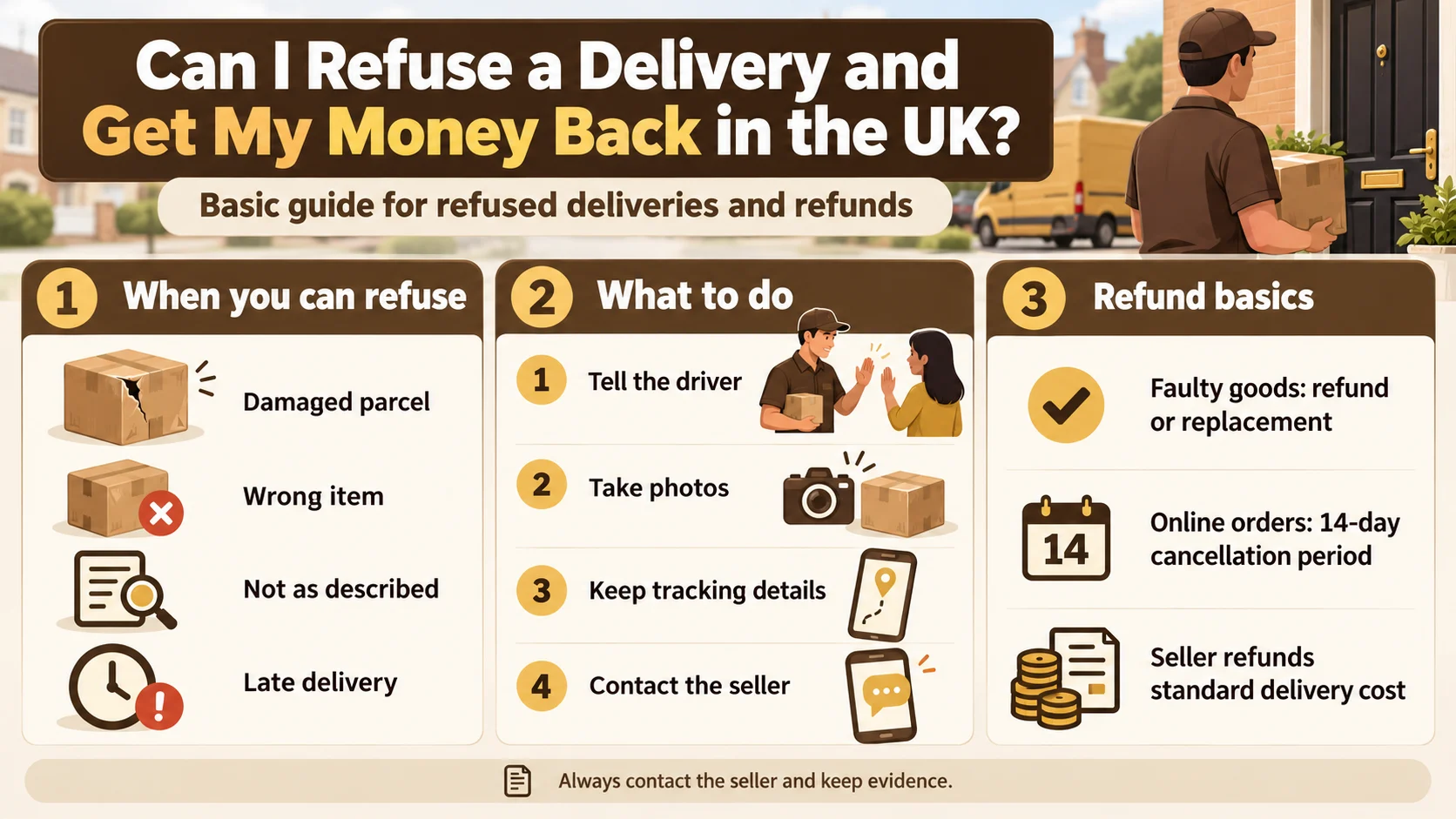
Yes, you can refuse a delivery in the UK, but refusing the parcel does not automatically create a refund in every situation. Your right to receive money back depends on why you rejected the goods, how you bought them, and whether you have formally notified the retailer.
Three legal situations commonly apply:
- The goods are damaged, faulty, not as described or unfit for purpose.
- An online or distance-sale customer has changed their mind.
- The retailer has failed to deliver within the agreed or legally required timeframe.
The retailer, rather than the delivery driver, normally remains your main point of contact for a refund.
What Happens If You Refuse a Delivery?
Refusing a delivery means telling the courier that you do not want to take possession of the parcel. The carrier may then record the shipment as refused and return it to the sender.
That physical refusal and your legal cancellation or rejection of the purchase are not necessarily the same action.
If you bought the goods from a retailer, contact the retailer directly and state clearly that you are cancelling the order, rejecting the goods or reporting a delivery problem.
For an online purchase, do not rely solely on the courier’s tracking status to tell the retailer what you want.
A practical refusal record should contain:
- order number;
- parcel tracking number;
- delivery date and time;
- courier company;
- reason for refusing the parcel;
- photographs of visible damage, where relevant; and
- written notification sent to the retailer.
Keep screenshots of tracking information and copies of emails or messages until the refund has been completed.
Can I Reject Damaged or Faulty Goods?
Yes. Goods supplied by a UK trader must meet statutory standards, including being of satisfactory quality, fit for purpose and as described.
A product that arrives broken or damaged may breach those requirements.
The Consumer Rights Act 2015 provides a short-term right to reject qualifying faulty goods within 30 days in many circumstances. Citizens Advice explains that consumers may have rights to a refund, repair or replacement where an item is broken, damaged, unusable or does not match its description.
You should normally contact the retailer rather than trying to resolve the statutory consumer claim solely with the courier.
What Evidence Should You Keep for Damaged Goods?
Photographs are useful evidence, but taking photographs is not normally a condition that creates your statutory rights.
If you see damage:
- Photograph the external packaging.
- Photograph visible damage to the product if you accept and open it.
- Save the tracking information.
- Record when the delivery took place.
- Notify the retailer promptly.
- Keep the packaging where practical until the retailer responds.
Evidence can help establish the condition of the parcel when a retailer, marketplace or carrier disputes what happened.
Can I Refuse a Parcel Because I Changed My Mind?
You may be able to cancel an online purchase even when nothing is wrong with the goods.
Most qualifying distance purchases receive a statutory cooling-off period under the Consumer Contracts Regulations 2013.
For goods, the cancellation period generally runs until 14 days after the day you receive them. After notifying the seller that you are cancelling, you normally have another 14 days in which to send the goods back.
Citizens Advice explains the applicable cooling-off period, exceptions and return process in its guidance on changing your mind about goods bought online, by telephone or by mail order.
The rules do not apply equally to every product.
Common exceptions can include:
- personalised or bespoke products;
- goods that deteriorate rapidly;
- certain sealed hygiene products after the seal has been broken;
- some sealed software or media after opening; and
- purchases from private individuals rather than traders.
Refusing the courier can assist with returning an unwanted parcel, but you should still give the retailer an explicit cancellation notice.
Does Refusing the Parcel Automatically Cancel the Order?
No. Do not assume a carrier’s “refused” tracking scan automatically satisfies every requirement for cancelling your contract with the retailer.
Send the retailer a clear written statement.
A simple notification can include:
I am cancelling this order and have refused delivery of the parcel. Please confirm the return and refund arrangements.
Include your order number, tracking number and delivery date.
Written communication creates a clearer evidence trail if the retailer later disputes the cancellation date.
How Long Does a Retailer Have to Refund an Online Order?
For a qualifying cancellation of an online goods order, the retailer generally has to make the refund within 14 days of receiving the returned goods or receiving evidence that you sent them back, whichever occurs first.
Citizens Advice provides the same refund and return timetable in its current guidance for distance purchases.
The refund should usually cover:
- the purchase price; and
- the basic or standard outbound delivery charge.
If you selected a premium service, such as next-day delivery when a cheaper standard service was available, the retailer does not normally have to refund the additional premium delivery cost.
The original draft stated that a refund had to be made within 14 days simply from the customer’s refusal notice. That is too broad. The applicable refund deadline for returned goods can depend on when the seller receives the goods or evidence of return.
Who Pays the Return Delivery Cost?
The answer depends on the reason for the return.
| Reason for return | Typical position |
|---|---|
| Goods are faulty or damaged | Retailer normally bears the reasonable return cost |
| Goods are not as described | Retailer normally bears the reasonable return cost |
| Consumer changes their mind after an online purchase | Consumer may have to pay return costs if correctly informed beforehand |
| Retailer voluntarily offers free returns | Retailer’s own policy applies |
| Bespoke or excluded products | Statutory cancellation rights may not apply |
Do not assume that every refused parcel must be collected free of charge.
The underlying reason for the rejection matters.
What If the Delivery Arrives Late?
Late delivery rights depend on what the retailer promised and whether the delivery date mattered to the contract.
If no different period was agreed, goods should generally be delivered within 30 days.
A consumer can have stronger cancellation rights where delivery by a particular date was essential — such as an item specifically required for an event — and the retailer fails to meet that deadline.
In other cases, you may need to give the retailer an additional reasonable opportunity to deliver before ending the contract.
Citizens Advice explains the difference between an agreed delivery date, the usual 30-day period and circumstances where a consumer can cancel an order because the seller failed to deliver it.
Is the Retailer or Courier Responsible for the Parcel?
For most consumer purchases, your contract for the goods is with the retailer.
That makes the seller the main party you should contact when:
- the goods do not arrive;
- the parcel is damaged;
- an incorrect product arrives;
- the package goes missing before delivery; or
- you want to exercise statutory rights against the seller.
A retailer should not simply tell a consumer to resolve every problem directly with its delivery contractor.
Carrier tracking can establish what happened operationally, but it does not remove the retailer’s contractual responsibilities.
What If the Parcel Is Left in the Wrong Place?
The answer depends partly on whether you authorised the location.
A parcel left at an agreed safe place, nominated neighbour or another location selected through your delivery preferences can be treated differently from a parcel left somewhere you never authorised.
If tracking states that a package was delivered but you did not receive it:
- Check the delivery photograph.
- Check your nominated safe-place settings.
- Ask household members or authorised neighbours.
- Contact the retailer.
- Preserve the carrier’s tracking information.
Do not assume that a carrier marking a parcel “delivered” settles the legal issue.
Can a Courier Driver Refuse to Take the Parcel Back?
Carrier procedures vary.
There is no single rule requiring every delivery driver from every carrier to process a doorstep refusal in exactly the same way.
Some networks support refusal at the point of delivery. Evri, for instance, states that a recipient can refuse a parcel at the door so it can be returned to the sender.
Other shipments may have different instructions because of:
- the carrier;
- service type;
- retailer contract;
- international customs procedures;
- controlled goods;
- proof-of-delivery requirements; or
- the stage reached in the delivery process.
If a driver cannot process your refusal, contact the retailer immediately and ask for the authorised return procedure.
What Happens If Nobody Is Home?
A missed delivery does not automatically mean the order has been refused.
The carrier may:
- attempt another delivery;
- offer a redelivery booking;
- redirect the parcel;
- hold it at a collection location;
- leave it at an authorised safe place; or
- eventually return it to the sender.
The exact procedure depends on the carrier.
There is no universal Consumer Rights Act rule requiring every UK courier to make three delivery attempts.
Evri currently states that where no suitable safe place is available or a signature is required, its courier may make up to three delivery attempts on consecutive working days. That is an Evri operating procedure, not a general statutory requirement imposed on every courier company.
Does Royal Mail Keep Undelivered Parcels for 18 Days?
Retention periods depend on the Royal Mail product concerned, so a single collection period should not be presented as applying to every shipment.
Royal Mail provides redelivery and collection procedures after unsuccessful delivery attempts, but customers should check the tracking information or card issued for their specific item.
Carrier operating rules can change independently of consumer legislation.
Should You Contact the Courier or Retailer First?
Contact the retailer first for consumer-rights and refund issues.
Contact the courier when you need operational information such as:
- current parcel location;
- proof of delivery;
- delivery photograph;
- redelivery options;
- depot information; or
- tracking clarification.
The retailer remains the stronger contact for questions involving:
- refunds;
- faulty goods;
- contractual delivery deadlines;
- cancellation;
- incorrect products; and
- statutory consumer remedies.
What Should You Do After Refusing a Delivery?
Create a written record immediately.
1. Record the refusal
Save:
- date;
- time;
- tracking number;
- carrier;
- order number; and
- refusal reason.
2. Photograph any visible damage
Capture the parcel from several angles where damage is relevant.
3. Contact the retailer
Tell the retailer whether you are:
- cancelling a distance purchase;
- rejecting faulty goods;
- reporting incorrect goods;
- reporting non-delivery; or
- requesting another remedy.
4. Keep tracking the return
A refused parcel can remain inside a carrier network for several days before reaching the sender.
5. Keep evidence until you receive the refund
Save tracking screenshots, emails, receipts and refund confirmations.
Can Your Bank Help If the Retailer Will Not Refund You?
Potentially.
Depending on the payment method and circumstances, consumers may have access to mechanisms such as:
- card chargeback;
- Section 75 protection for qualifying credit-card transactions;
- PayPal or marketplace dispute procedures; or
- a Buy Now Pay Later provider’s dispute process.
These mechanisms have their own eligibility requirements and should not be treated as substitutes for contacting the retailer first.
If a dispute remains unresolved, consumer advice organisations can explain the next available steps.
Refusing a Delivery: Quick Reference
| Situation | Refuse at door? | Contact retailer? | Possible refund right? |
|---|---|---|---|
| Goods visibly damaged | Yes | Yes | Often |
| Wrong product | Yes | Yes | Often |
| Product not as described | Yes | Yes | Often |
| Changed mind on qualifying online purchase | Usually possible | Yes | Usually within cancellation rules |
| Delivery misses an essential agreed deadline | May be unnecessary | Yes | Potentially |
| You simply missed the driver | No | Usually not immediately | Not automatically |
| Personalised goods | Possible physically | Yes | Cooling-off right may be excluded |
| Perishable goods | Possible physically | Yes | Cooling-off right may be excluded |
The main distinction is simple: refusing the parcel controls physical possession; cancelling or rejecting the purchase determines your legal claim against the retailer.
Treat them as two related actions rather than the same process.
Frequently Asked Questions
Can I refuse a parcel before signing for it?
Yes. You can tell a driver that you do not want to accept a parcel, although the carrier’s procedure determines how the refusal is recorded. If you are cancelling an order or rejecting goods, also notify the retailer directly. Do not rely exclusively on a tracking scan marked “refused” to establish your statutory claim.
Can I refuse damaged packaging without opening it?
You can decline to accept a visibly damaged parcel. Photographing the damage and recording the tracking number can strengthen the evidence available to you. The legal claim normally concerns the condition and conformity of the goods, however, so damaged outer packaging does not automatically prove that the product itself is faulty.
Do I need photographs to claim a refund?
Photographs are not normally what creates your statutory consumer rights, but they can provide useful evidence. Keep images of damaged packaging, delivery photographs, tracking records, messages and receipts where a dispute could arise. The stronger your documentary record, the easier it becomes to demonstrate what happened during delivery.
Can I change my mind after accepting delivery?
For many qualifying online purchases, yes. The statutory cooling-off period generally gives you 14 days after receiving the goods to tell the trader that you want to cancel. Exceptions apply, including certain personalised, perishable and sealed goods. After cancellation, you normally receive a further period in which to return the item.
Will refusing delivery guarantee a full refund?
No. Refusing the parcel alone does not guarantee a refund. Your entitlement depends on the contract, the reason for rejection, the type of goods and the relevant consumer rules. Contact the retailer, state the legal or contractual basis of your request and retain evidence showing that the parcel was refused or returned.

Martin Smith is an industry expert with more than 30 years’ experience in the parcel delivery and logistics. Martin is considered an industry professional in the UK Courier World.


