
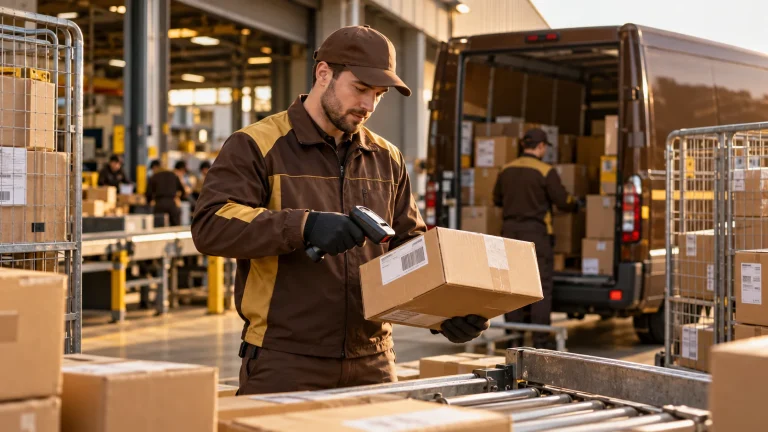
What Does “Parcel in Transit” Mean?
“Parcel in transit” means a courier has accepted a consignment into its delivery network and the parcel is progressing towards its destination. It may be travelling between sorting centres, waiting at a depot, passing through customs, or awaiting transfer to the next vehicle.
The status describes the parcel’s position within the logistics process rather than its exact physical movement at that second.
A parcel normally remains in transit after leaving its initial warehouse or sorting facility and moving between logistics hubs. The status usually changes when the consignment reaches another operational stage, such as at local depot, out for delivery, delivered, customs clearance, or a carrier-specific exception.
This distinction matters because “in transit” does not necessarily mean the parcel is currently travelling on a truck, aircraft or another transport service. It can remain inside a courier depot for several hours while waiting for sorting, trunk transport, customs processing, or its next scheduled connection.
What Does “Parcel in Transit” Actually Mean?
An in-transit parcel is a consignment that has entered the courier’s transport network but has not completed its journey to the receiver.
The basic relationship is:
Courier → transports → consignment → through logistics network → to receiver
A tracking system records events during that journey and converts them into statuses that the sender or receiver can understand.
Three terms often cause confusion:
| Tracking Status | What It Usually Means | Typical Parcel Location |
|---|---|---|
| Despatched | The sender has released the parcel or created the shipment for collection. | Sender, collection point or origin facility |
| In Transit | The courier network is processing or transporting the parcel towards its destination. | Sorting centre, depot, transport vehicle, airport or transfer facility |
| Out for Delivery | The parcel has entered the final-mile delivery run. | Local delivery vehicle or final delivery route |
The critical difference is that in transit covers the middle section of the journey, while out for delivery refers to the final local delivery stage.
How Does a Parcel Enter the Courier Network?
The transit process starts when a courier, postal operator, drop-off location or collection point accepts the physical parcel.
A typical journey follows this sequence:
- The sender prepares and labels the parcel.
- A collection driver or drop-off facility accepts it.
- The parcel reaches an origin depot or sorting centre.
- A scanner records the consignment identifier.
- Sorting equipment or depot staff allocate the parcel to its next route.
- The consignment moves towards another distribution hub or destination depot.
- The final depot assigns it to a delivery route.
- A local driver completes the last-mile delivery.
Each stage can create a new tracking event.
A parcel’s tracking history is therefore a digital record of physical events occurring across multiple logistics nodes rather than a continuous GPS trace of the package itself.
What Role Does the Origin Sorting Centre Play?
The origin sorting centre determines where a parcel needs to travel next.
Modern parcel networks process consignments using shipping labels containing destination data such as the recipient’s address, postcode and machine-readable barcode. Automated systems can read this information and direct each parcel towards the correct cage, conveyor, vehicle, route or regional facility.
Accurate labelling matters because damaged barcodes, incomplete postcodes and incorrect addresses can interrupt automated processing. Following good parcel labelling practices before sending a shipment reduces the chance of a parcel being rejected for manual handling.
The sorting centre therefore performs two connected functions:
Parcel identification → route allocation
Once the destination route has been assigned, the consignment can enter the next transport stage.
How Is the First “In Transit” Tracking Event Created?
An in-transit event normally begins when a courier’s operational system records a physical or administrative movement associated with the parcel.
A barcode may be scanned when the parcel:
- enters a depot;
- leaves a sorting facility;
- is assigned to a vehicle or container;
- reaches another distribution centre;
- enters an export facility;
- clears a processing checkpoint.
The scan connects the parcel’s unique tracking identifier with a location, event and timestamp.
The tracking platform can then display that information to the sender or receiver.
This explains why tracking is event-based rather than continuously updated. A parcel can physically travel hundreds of miles between one recorded scan and the next.
How Does a Courier Network Transport Parcels?
Courier networks move parcels through a chain of interconnected collection points, depots, sorting centres and transport routes.
Domestic deliveries commonly depend on road transport. International consignments may combine road haulage with air freight, sea freight or specialist cross-border transport.
The transport chain can therefore contain several separate movements:
Collection vehicle → origin depot → trunk vehicle → regional hub → destination depot → delivery van
Each transfer represents another logistics node.
This structure allows a courier to combine thousands of individual parcels into larger vehicle movements rather than transporting each consignment directly from sender to recipient.
How Does Hub-and-Spoke Parcel Delivery Work?
Many large courier businesses use a hub-and-spoke distribution model.
Local depots act as spokes connected to larger regional or national sorting hubs. Parcels collected from one area travel to a hub, where the network separates them according to their destination.
A parcel travelling from one UK region to another might follow this pattern:
Local collection → origin depot → central or regional hub → destination depot → local delivery
Long-distance transfers between major sorting centres are often called trunking. Heavy goods vehicles can carry cages, pallets or containers containing many consignments during these trunk movements.
This model allows a courier network to consolidate parcel volumes while maintaining scheduled connections between regions.

How Do International Parcels Move Between Countries?
International parcel transit adds export processing, international transport and border clearance to the domestic delivery chain.
A typical international movement can include: Sender → UK collection network → export facility → international freight movement → customs facility → destination-country network → local depot → receiver
Depending on the service and destination, the international movement might involve air freight, road freight, sea transport or several modes.
This explains why sending a parcel abroad from the UK can create more tracking events and longer gaps between scans than a domestic delivery.
The parcel may also remain inside a secure customs or freight facility while retaining an in-transit-related status.
How Do Tracking Technologies Record Parcel Movement?
Parcel tracking depends mainly on a combination of identification technology, scanning hardware, logistics databases and software integrations.
Common components include:
- barcodes and machine-readable shipping labels;
- handheld courier scanners;
- automated sorting scanners;
- depot management systems;
- vehicle and route management software;
- tracking databases;
- APIs connecting courier systems with retailers and customer portals;
- RFID systems in logistics environments where suitable infrastructure exists.
These technologies connect the physical parcel with its digital shipment record.
What Role Do Barcode Scanners and RFID Systems Play?
Barcode scanning identifies an individual shipment at defined processing points.
When a worker or automated sorting system scans the label, the courier’s database can associate the parcel with an event such as received at hub, departed facility, arrived at depot or loaded for delivery.
RFID operates differently. Radio-frequency identification can identify tagged items without the same line-of-sight requirement as a traditional barcode scanner.
However, consumers should not assume every parcel carries an RFID tag. Barcode-based tracking remains common across parcel delivery operations.
The customer-facing tracking history is therefore usually a sequence of recorded operational events rather than a second-by-second location feed.
How Do APIs Provide Parcel Tracking Information?
An Application Programming Interface (API) allows one computer system to exchange structured tracking information with another.
For instance, a courier’s internal platform may record: Tracking number → scan event → depot → timestamp → shipment status
An API can then send selected information to:
- the courier’s tracking website;
- an online retailer;
- an eCommerce platform;
- a customer notification system;
- a third-party tracking application.
This explains why the same parcel status can appear simultaneously on several platforms.
It also explains why a tracking page can occasionally lag behind the physical parcel. The delivery operation and the customer-facing system do not always update at exactly the same moment.
How Do Customs Procedures Affect International Parcels in Transit?
Customs processing creates an additional control stage for international shipments.
Depending on the origin, destination, carrier, postal system and type of goods, authorities may require customs information covering the parcel’s contents, value, purpose and commodity classification.
Documentation can include commercial invoices, customs declarations and commodity or Harmonised System classification information.
If the required information is incomplete, inconsistent or requires examination, the parcel may stop progressing until the issue has been resolved.
The physical parcel has not necessarily been lost. It may simply be waiting inside the border-clearance process.
What Customs Documentation Can Affect Parcel Transit?
International shipping documentation varies according to the destination, operator and type of consignment.
Relevant information can include:
- sender and receiver details;
- an accurate description of the goods;
- quantity;
- declared value;
- country of origin;
- commodity or HS classification;
- commercial invoice information;
- CN22 or CN23 documentation where the postal service and destination require it;
- licences or certificates for controlled goods.
Missing or inaccurate information can delay clearance because customs authorities need sufficient data to classify the shipment and apply the correct controls, duties or taxes.
The sender should therefore check the requirements for the specific destination and carrier rather than assuming that one customs form applies to every international parcel.
Can Import VAT or Customs Duties Delay a Parcel?
Yes. A parcel can be held when customs charges, taxes, duties or handling fees require payment before the shipment can continue.
The tracking message may then change to wording such as:
Awaiting customs clearance
Customs charges due
Held for payment
Customs processing
The exact wording depends on the carrier and destination country.
Once the relevant customs requirement has been satisfied, the parcel can return to the normal delivery network.
How Long Does a Parcel Usually Stay in Transit?
There is no universal transit period because delivery time depends on the service purchased, origin, destination, courier network, working days, collection cut-off, transport connections and customs requirements.
A domestic express service may travel through the network much faster than an economy international shipment.
The estimated delivery date supplied by the courier should therefore be treated as the most relevant reference for that individual consignment.
An important distinction also exists between transit time and elapsed calendar time. A service measured in working days may exclude weekends or public holidays.

What Determines a Parcel’s Estimated Delivery Date?
Courier systems calculate estimated delivery dates using known characteristics of the shipment and delivery service.
These can include:
- origin postcode;
- destination postcode;
- collection time;
- service level;
- scheduled hub connections;
- depot processing windows;
- distance;
- vehicle schedules;
- weekend operations;
- customs requirements for international shipments.
The estimated delivery date is therefore linked to the logistics route rather than simply the physical distance between sender and receiver.
Two parcels travelling the same distance can have different delivery dates when they use different service levels or distribution routes.
What Does “Stuck in Transit” Mean?
A parcel is commonly described as stuck in transit when its tracking status remains unchanged longer than expected and no new movement or processing event appears.
That does not automatically mean the parcel is lost.
The parcel could be:
- waiting for its next trunk connection;
- delayed at a sorting facility;
- undergoing customs clearance;
- awaiting address correction;
- affected by transport disruption;
- waiting to be manually processed;
- moving between locations without receiving another customer-visible scan.
Domestic and international parcel movements can experience different periods without visible tracking activity, particularly where customs or cross-border freight connections form part of the route.
A delayed parcel should also not be confused automatically with one recorded as lost in transit. A carrier normally needs to investigate the consignment before confirming that it cannot be located.
Why Do Parcels Become Stuck in Transit?
Transit delays usually occur because an expected physical movement, scan or processing event did not happen within the normal timeframe.
Incorrect or Incomplete Delivery Address
Incorrect house numbers, missing flat details, invalid postcodes and incomplete address information can prevent automated systems from routing a parcel correctly.
A rejected shipment may need manual intervention before it can re-enter the correct delivery stream.
Customs Clearance
International shipments can stop at border facilities while authorities or carriers review declarations, commodity information, invoices or taxes.
The parcel may remain physically secure at the facility even when the customer sees no new movement on the tracking page.
Severe Weather and Transport Disruption
Snow, flooding, strong winds, road closures, cancelled flights and other transport interruptions can prevent vehicles from reaching distribution centres on schedule.
A disruption at one major facility can also affect other parts of the courier delivery network because later vehicle connections depend on parcels arriving within specific processing windows.
Peak Parcel Volumes
Black Friday, Christmas, major retail promotions and other demand peaks can place extra pressure on sorting centres, vehicle capacity and final-mile routes.
Courier businesses can increase capacity, but unusually high parcel volumes and changing delivery requirements can still produce temporary backlogs.
Damaged Labels or Packaging
A damaged label can prevent scanning equipment from identifying the parcel.
Poor packaging can also require manual inspection if a box becomes damaged, opens during processing or presents a handling problem.
Misrouting
A parcel may enter the wrong route, cage, vehicle or depot.
The courier must then redirect the consignment back towards the correct distribution path. The tracking page might show an unexpected facility or a longer-than-normal gap while that correction occurs.
In Transit vs. Out for Delivery: What’s the Difference?
In transit means the parcel is still moving through the wider courier network. Out for delivery means it has reached the final delivery operation and has normally been assigned to the local delivery route.
| Tracking Status | Meaning | Likely Parcel Location | Delivery Stage |
|---|---|---|---|
| In Transit | The courier network is transporting or processing the parcel. | Hub, depot, vehicle, airport, customs facility or between locations | Middle of journey |
| Out for Delivery | The parcel has entered the final-mile delivery run. | Local delivery vehicle or route | Final delivery stage |
“Out for delivery” provides a much stronger indication that delivery is expected soon, although traffic, vehicle problems, route capacity or failed delivery attempts can still prevent arrival that day.
See the In Transit vs. Out for Delivery parcel tracking graphic
Why Has My Parcel Tracking Not Updated?
A lack of tracking updates does not necessarily mean the parcel has stopped moving.
Tracking systems depend on recorded events. A parcel travelling between two distant distribution centres may not generate another visible status until it reaches the next scanning point.
Other possibilities include:
- a scan was missed;
- a scan has not yet appeared on the customer portal;
- the parcel is travelling between hubs;
- the courier groups several internal events under one public status;
- the parcel is awaiting manual processing;
- an international shipment is undergoing border processing.
Some third-party tracking services also explain that tracking information can appear after a delay.
The expected delivery date and carrier-specific tracking history provide more useful evidence than the words “in transit” alone.
What Should You Do When Tracking Stops Updating?
Start by comparing the latest scan with the courier’s estimated delivery date.
If the parcel remains within the expected delivery period, another tracking event may appear after the shipment reaches its next processing point.
If the delivery estimate has passed:
- Check the complete tracking history.
- Confirm that the delivery address is correct.
- Look for customs or payment notifications.
- Contact the sender or retailer.
- Provide the shipment’s tracking number when requesting an investigation.
- Follow the carrier’s missing-parcel or claims procedure if the shipment exceeds its investigation threshold.
For retail purchases, contacting the seller is often the practical first step because the merchant normally arranged the delivery service and can raise an enquiry through its courier account.
How Will Parcel Tracking Develop?
Parcel tracking systems are becoming more data-driven as carriers combine shipment events with route information, vehicle data, network capacity and predictive modelling.
Future improvements are likely to focus less on adding more generic tracking messages and more on making existing shipment information more accurate.
Predictive systems can analyse variables such as:
- historical journey times;
- parcel volumes;
- depot capacity;
- road conditions;
- transport schedules;
- weather;
- previous delivery performance.
The objective is to identify a probable delay before a parcel misses its planned connection.
This could allow a network to alter vehicle allocation, processing priorities or routing earlier in the journey.
How Could Predictive Analytics Reduce Transit Delays?
Predictive analytics can compare current shipment conditions with historical network patterns.
A logistics platform might detect that a distribution centre is receiving more parcels than expected or that a scheduled transport route is likely to encounter disruption.
The carrier could then allocate extra capacity or redirect suitable traffic before the affected shipments accumulate at one location.
For customers, the most useful result would be a more accurate estimated delivery time rather than simply another tracking status.

What Role Could Autonomous Freight Play in Parcel Transit?
Automated and autonomous vehicle technologies could eventually change some hub-to-hub freight operations, particularly repetitive trunk routes between major logistics facilities.
The practical effect will depend on vehicle capability, road regulation, safety requirements, infrastructure and commercial adoption.
Human drivers remain central to current road-freight and parcel operations, so fully autonomous trunking should be treated as a developing transport model rather than an established replacement for conventional courier networks.
The nearer-term change is likely to come from better route forecasting, automated sorting and more detailed digital shipment data.
These systems also connect directly with developments in last-mile delivery and automated routing, where the challenge changes from moving thousands of parcels between major hubs to delivering individual consignments to specific addresses.
Frequently Asked Questions
What should I do if my parcel is stuck in transit?
Check the estimated delivery date before assuming that the parcel has stopped moving. A shipment can travel between hubs without generating a new customer-visible scan. If the delivery estimate has passed, contact the sender or retailer and provide the parcel tracking number needed to investigate the shipment. The sender can often raise an enquiry through its courier account. If the delay continues, follow the carrier’s published missing-parcel or claims process.
Can I collect a package that is in transit?
Sometimes, but collection depends on the courier, parcel location and service conditions. A parcel travelling between hubs normally cannot simply be removed from the network. If it has reached a local depot, the carrier may allow collection, redirection or delivery to a pickup point. Contact the courier and provide the tracking number and parcel identification details. Some postal operators also provide parcel interception or redirection options for eligible shipments.
Is my parcel lost if it is stuck in transit?
No. A parcel with an unchanged in-transit status is delayed or has not generated another visible tracking event; that alone does not prove loss. The consignment could still be travelling, waiting at a hub or undergoing customs processing. If the parcel exceeds the carrier’s expected delivery and investigation periods, contact the seller or courier. Different carriers apply different timescales before a shipment can be investigated or treated as potentially lost.
Why hasn’t my tracking information changed?
Tracking normally changes when the courier records another processing or transport event. A long-distance shipment can travel between major hubs without receiving a public scan during every stage. The parcel could also have missed a scan or be awaiting processing. Third-party tracking systems note that parcel information may not always appear immediately after a movement. Check the expected delivery date and full tracking history before deciding that the shipment has stopped.
Does in transit mean my parcel will arrive today?
No. “In transit” means the parcel remains within the courier’s transport and processing network; it does not normally confirm delivery that day. A status such as out for delivery is a stronger indication that the parcel has reached the final-mile stage. The consignment may still need to pass through another hub, local depot, customs facility or scheduled transport connection before a delivery driver receives it.

Martin Smith is an industry expert with more than 30 years’ experience in the parcel delivery and logistics. Martin is considered an industry professional in the UK Courier World.


