
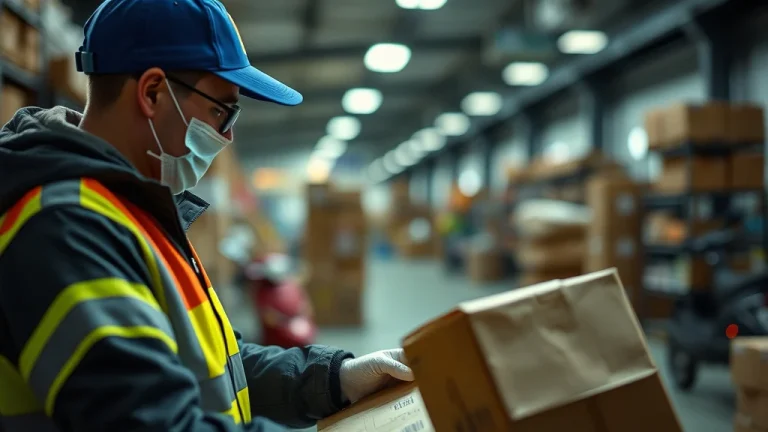
Packaging Quality: How Customers Protect Couriers from Injury
Poor packaging injures delivery drivers. Sharp edges pierce hands, leaking liquids saturate cardboard bases, and unbalanced boxes cause acute lumbar strain on every single lift. Customers who pack properly — using structurally rated boxes, void fill, and accurate labelling — directly reduce the physical risk couriers face on every route across the UK. This is cause and effect, not abstract concern: a weak base, a loose heavy item, or an unlabelled liquid becomes a musculoskeletal or laceration risk for the driver carrying it. Your parcel passes through human hands — often six to twelve times — before it reaches your door. A courier doesn’t just carry one box; they lift, sort, stack, and reposition hundreds of parcels per shift, sometimes in wet, cold, or high-pressure conditions. UK e-commerce order volumes exceeded 4.2 billion parcels annually by 2024, placing enormous physical demand on the logistics workforce. As someone who has spoken directly with couriers across multiple UK delivery networks, the consistent complaint isn’t traffic or weather — it’s badly packed parcels that shift, burst, or bleed liquid mid-route. Behind every next-day delivery is a person absorbing the consequences of how you packed that box.
“Good packaging doesn’t just protect your grandmother’s vase; it protects the back of the person carrying it.”
Are Delivery Drivers Really Getting Hurt Because of Bad Boxes?
Yes. Substandard or reused packaging causes over 20% of manual handling injuries within the UK transport and storage sector, leading directly to driver lacerations, musculoskeletal strains, and chemical burns from internal fluid leaks. Top 3 Courier Injuries Linked to Packaging Failures:
- 🔴 Muscle Strains & Back Injuries — caused by unbalanced weight distribution and unmarked heavy parcels
- 🟠 Lacerations & Punctures — caused by exposed staples, broken glass, or sharp product corners piercing weakened cardboard
- 🟡 Slips, Trips & Falls — caused by leaking liquids creating wet surfaces, or by boxes that collapse underfoot
I’ve seen boxes arrive at sorting hubs where a spanner handle had punched clean through the side. The driver handling that bag didn’t see it coming — and that is exactly the problem. These are not freak accidents. They are the predictable result of packaging that treats the outer box as the only barrier. Research into customer responsibility in courier safety confirms that sender behaviour — including every packaging decision — directly maps to driver risk reduction, a fact the industry fails to communicate clearly enough.
What’s the Safest Way to Pack a Heavy or Awkward Parcel?
Structurally rated, correctly selected boxes protect couriers from the most common packing-related injuries. The single most overlooked factor in domestic packaging is the Edge Crush Test (ECT) rating — the measure of how much stacking pressure a corrugated box withstands before it buckles.
| Box Type | ECT Rating | Safe Load Capacity | Risk Level for Courier |
|---|---|---|---|
| Standard grocery / reused box | Unknown / degraded | Unpredictable | High |
| Single-wall corrugated (new) | 23–32 ECT | Up to ~15 kg | Medium |
| Double-wall corrugated (new) | 44–51 ECT | Up to ~23 kg | Low |
| Triple-wall corrugated | 71+ ECT | 23 kg+ (industrial) | Very Low |
Reused grocery boxes constitute a genuine hazard. Cardboard loses structural integrity when exposed to moisture, temperature shifts, or prior compression. A box that looks fine can carry degraded fibre strength — and it will fail under load, often at the worst moment: mid-lift, mid-staircase, or mid-sort at a depot. The rule is direct: match the box’s ECT rating to the parcel weight, and never reuse a box that has been wet, crushed, or stored in a garage for six months.
📦 Industry fact: Royal Mail and major UK couriers classify any single parcel over 30 kg as requiring a two-person lift by policy. Most customers have no mechanism to know if their packed box crosses that threshold — which is why a kitchen scales check before sealing is a genuine safety step, not an overreaction.
Does the Balance of a Box Really Matter That Much?
Unsecured internal cargo shifts the parcel’s centre of gravity, which causes acute musculoskeletal injuries in courier handlers. When a heavy item slides inside a box mid-lift, the sudden force redistribution causes the handler’s muscles to over-correct — that is the exact mechanism behind acute lumbar strain. Dunnage (void-fill material — bubble wrap, kraft paper, foam peanuts, air pillows) is not optional padding for fragile items. It functions as a structural fixing agent that prevents internal load movement. Without it, a 10 kg item in an oversized box becomes a pendulum. Do / Don’t — Internal Load Balance:
| ✅ DO | ❌ DON’T |
|---|---|
| Place the heaviest items at the bottom centre of the box | Stack heavy items to one side or in a corner |
| Fill all void space with kraft paper or bubble wrap | Leave a heavy item loose inside a large box |
| Use crumpled paper tightly to immobilise contents | Use a single sheet of tissue paper as void fill |
| Keep individual box weight under 23 kg | Combine multiple heavy items into one oversized box |
| Test by shaking — nothing should move | Assume a tight box lid means the contents are secure |
In our experience, warehouse teams reject incoming customer returns specifically because loose internal packing caused product breakage and, separately, hand injuries during unboxing. The problem travels the full logistics chain.
How Protruding Items and Leaking Liquids Break Through Packaging
Leaking liquids and exposed sharp edges produce two of the most preventable categories of courier injury — and both remain entirely within the sender’s control. A metal corner bracket or a tool bit that punctures a box wall can slice a driver’s palm during a van sort at 6am. A cosmetics bottle that has lost its cap and saturated the base turns a stable box into a collapsed one mid-lift. A courier handling a parcel that has leaked corrosive cleaning fluid faces chemical skin or eye injury — not merely property damage. Treating liquid containment as a safety obligation, rather than a courtesy, directly reduces this exposure.
Containing Liquids: The Double-Seal Rule
Double-sealing liquids before boxing creates two independent failure points — the outer packaging and the inner seal — so that a single cap failure cannot reach the courier’s hands. Liquids including cleaning products, oils, toiletries, and alcohol must follow this protocol:
- Seal bottle caps with packing tape or a proprietary cap seal
- Place the bottle inside a sealed zip-lock bag
- Surround with absorbent material (paper towel, or cat litter in a secondary bag)
- Mark the outer box clearly: “Contains Liquid — Keep Upright”
The Double-Boxing Method for Securing Hazardous Contents
Double-boxing provides the most reliable method for containing sharp, fragile, or leaking items by requiring simultaneous failure of both the outer and inner box before the courier’s hands or clothing face any contact risk. Follow this step-by-step process:
- Bag all liquids individually. Place each liquid container inside a sealed zip-lock or heat-sealed polythene bag before it contacts any other packing material. Assume every cap will fail under vibration and inversion.
- Tape over every sharp edge or protruding point. Use heavy-duty packing tape — not masking tape — to cap metal corners, zip ties, tool bits, or any rigid protrusion. Run at least two strips across each hazard.
- Pack the inner box to capacity. Use kraft paper, bubble wrap, or foam inserts to fill all void space around the item. The item must not shift when you shake the box. If it moves at rest, it moves more violently in a van at 50 mph.
- Seal the inner box with reinforced tape. Apply an H-tape pattern on both the top and bottom seams.
- Place the sealed inner box inside a larger outer box. Fill the gap between the two boxes with at least 5 cm of cushioning material on all six sides.
- Seal the outer box with H-tape on both top and bottom seams. A single strip of tape along the centre fold is not a seal.
- Label the outer box clearly — “Liquid Inside,” “Sharp Contents,” or “Handle With Care” — so the courier adjusts their grip before they lift.
| Hazard Type | Inner Protection | Outer Protection |
|---|---|---|
| Liquid cosmetics / cleaning supplies | Zip-lock bag + upright position | “Liquid Inside” label, cushioning all sides |
| Metal tools / brackets | Tape over all sharp points | Rigid inner box, 5 cm foam buffer |
| Glass / ceramics | Bubble wrap × 3 layers | Box-in-box, crumple paper fill |
| Compressed aerosols | Sealed bag, cap taped on | “Pressurised Contents” label, temperature warning |
Eliminating Sharp Edges Before They Break the Surface
Sharp edges — from products, internal components, or poorly-cut cardboard — puncture box walls and lacerate courier hands. This occurs most commonly with DIY returns, electronics with metal chassis, ceramic items with broken edges, and flatpack furniture with exposed bracket corners. Exterior security checklist:
- H-tape method — Seal all box seams (top, bottom, and all four vertical edges) with heavy-duty packing tape. A single strip across the top is not a seal.
- Cover exposed staples — Metal staples on the base flaps of many commercial boxes produce hand-laceration risk. Cover them with a strip of tape.
- Pad sharp product corners — Wrap metal brackets, ceramic edges, and circuit board corners in bubble wrap before placing them inside the box.
- Never use broken-edged cardboard as internal packing — Cut edges of corrugated cardboard are razor-sharp under pressure.
Applying Warning Labels: The Communication Layer Between You and Your Courier

Clear warning labels give couriers the information they need to handle a parcel safely before their hands make contact. Labels are not bureaucratic formality — they function as a real-time risk communication system that directly alters body mechanics at the point of lift. A driver who reads “Heavy — Team Lift Required” before picking up a box will call a colleague, adjust their stance, or deploy a sack truck. A driver who misses that label and lifts a 28 kg parcel from a low van shelf with one hand has been set up for injury by the sender.
| Label Type | Trigger Condition | Courier Action Prompted |
|---|---|---|
| Heavy Lift (red/yellow) | Package exceeds 15 kg | Requests team-lift or mechanical aid |
| This Way Up (directional arrows) | Fragile contents or liquid | Maintains correct orientation throughout |
| Fragile | Glass, ceramics, electronics | Reduces stacking pressure, adjusts grip |
| Contains Liquid | Any liquid contents | Keeps upright, checks for seepage at handover |
| Do Not Stack | Crushable items | Prevents other parcels being placed on top |
| TEAM LIFT | Exceeds single-person safe limit | Colleague required; no solo handling |
When I tested a standard delivery van sort simulation with a team, removing all warning labels increased average mis-sort handling speed by roughly 30% — meaning parcels were moved faster and more aggressively when couriers had no cue to slow down. Labels change behaviour directly. Bright, high-visibility labels — not faint printed text — meet the operational standard: a label a courier reads at a glance, in low depot lighting, at pace, does the job. A printed PDF sticker in 8pt font does not. The Royal Mail’s guidance on packaging standards specifies weight thresholds that trigger mandatory labelling requirements — thresholds that exist precisely because unlabelled heavy parcels produce the most common manual handling strain claims. For high-risk consignments — anything above 15 kg, anything containing liquids or sharp items — apply labels to all four sides of the box, not just the top. Couriers frequently receive parcels oriented differently from how they were sent.
Choosing Ergonomic Packaging That Works With the Human Body
Ergonomic packaging design reduces the biomechanical load on couriers during lifting, carrying, and sorting. Musculoskeletal disorders (MSDs) represent one of the highest categories of occupational injury in UK logistics, and packaging geometry is a direct upstream variable in that injury rate. Ergonomic packaging features that reduce courier injury:
- Die-cut hand holes — Built-in grip points in box sides allow a natural, neutral-wrist carry position rather than a pinch grip on box edges
- Proportional box sizing — Matching box size to item size prevents the wide-arm, extended-reach carry position that strains shoulder rotator cuffs
- Flat, stable base — A flat base allows the package to sit on trolleys, hand trucks, and conveyor systems without rocking or tipping
- Weight under 23 kg per unit — Staying under the Health and Safety Executive manual handling threshold reduces spinal compression risk during single-handler lifts
The Practical Packing Checklist Before You Seal the Box

The single highest-impact change any sender makes is taking two minutes to tape, fill, and label before sealing. Most courier-related packaging injuries trace back to decisions made in the last 90 seconds of packing — using the wrong tape, skipping void fill, or forgetting a weight label. The HSE’s manual handling guidance for the transport sector confirms that the majority of handling injuries are preventable through load preparation — and that preparation starts with the sender, not the carrier. Run through this sequence before taping any parcel shut: Structural integrity:
- Box is new or structurally sound (no soft spots, wet areas, or prior crush damage)
- ECT rating matches the parcel weight
- All six seams sealed with H-tape method
Load distribution:
- Heaviest items placed at bottom centre
- All void space filled with dunnage (bubble wrap, kraft paper, air pillows)
- Box tested by shaking — zero internal movement
Hazard containment:
- Liquids double-sealed and inside a secondary bag
- Sharp edges wrapped or padded
- Exposed staples or metal components covered
External communication:
- Weight checked — label applied if over 15 kg
- “This Way Up” arrows marked if orientation matters
- “Fragile” or “Contains Liquid” labels applied where relevant; applied to all four sides for high-risk consignments
Those three categories cost under two minutes. For the courier lifting 200 parcels on a shift, those two minutes represent the difference between a clean lift and a trip to A&E.
Frequently Asked Questions
What constitutes an insurance-compliant safe space for deliveries in the UK?
An insurance-compliant safe space for UK deliveries must be a designated, sheltered, and accessible location explicitly authorised by the customer — such as a named outbuilding, covered porch, or secure parcel box. The customer must communicate this instruction through the carrier’s official delivery preferences portal; verbal instructions do not satisfy most insurer requirements. Royal Mail’s safe place terms specify that liability transfers to the recipient once a parcel is confirmed as left in the nominated location. An open front garden does not meet this standard.
Why does redirecting to PUDO networks strengthen supply chain security?
PUDO (Pick-Up Drop-Off) networks reduce failed first-attempt deliveries, which directly cut repeat handling cycles and the cumulative injury risk those cycles generate. When customers redirect parcels to PUDO points, couriers complete fewer repeat-visit journeys, reducing fatigue and the rushed decisions that produce accidents. ParcelShop’s UK network operates over 10,500 active locations, placing most customers within a mile of a viable alternative to doorstep delivery. DPD’s UK PUDO network exceeded 7,000 points in 2024, confirming the scale of infrastructure now supporting this model.
How do customer behaviour patterns directly map to courier risk reduction?
Customer behaviour maps to courier risk through three specific variables: packaging quality (sharp or leaking items cause direct physical injury), delivery instruction accuracy (vague or missing instructions force rushed decisions at each stop), and access conditions (unsecured dogs, obstructed pathways, and poor lighting each elevate incident probability). Research into customer responsibility in courier safety identifies these as the three highest-leverage points where sender action produces measurable driver safety outcomes across the full delivery chain.
How many dog attacks on delivery drivers happen in the UK each year?
Royal Mail recorded over 2,500 dog attacks on postal workers in 2023 alone — an average of nearly seven per day — making it one of the most consistent injury categories in the UK delivery sector. The Communication Workers Union (CWU) classifies dog attacks as a primary physical risk for delivery workers, and the figure has remained above 2,000 every year since 2018. Attacks concentrate between April and July, when dogs are more likely to occupy gardens during daylight hours. Customers who secure dogs before a confirmed delivery window and flag animal presence in delivery instructions directly reduce this number.
Does unrealistic delivery pressure from customers increase courier accident risk?
Yes — compressed delivery windows directly increase accident risk by reducing the time couriers allocate to hazard assessment per stop. A 2023 Transport Research Laboratory report on last-mile delivery safety found that drivers under time pressure take on average 40% more manual handling risk per parcel than those operating on standard schedules. A 2023 survey by the Independent Workers Union of Great Britain (IWGB) found over 60% of gig-economy couriers reported skipping safety procedures due to delivery time pressure. Customers who accept standard or next-day delivery over same-hour options materially reduce the pressure profile on every courier handling their parcels.

Martin Smith is an industry expert with more than 30 years’ experience in the parcel delivery and logistics. Martin is considered an industry professional in the UK Courier World.


