
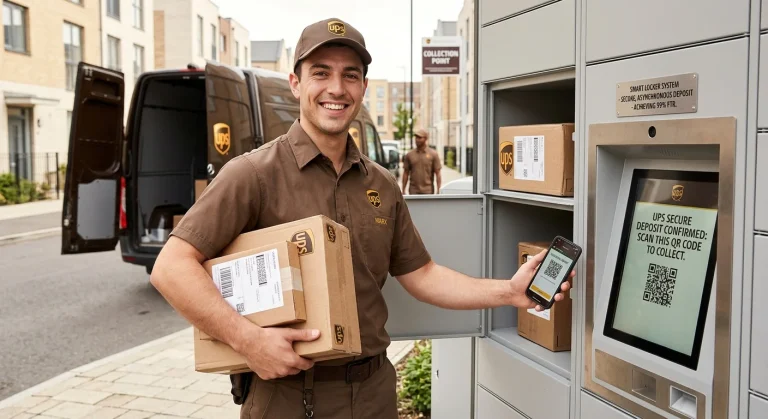
Do They Reduce Failed Deliveries?
Digital locker systems paired with QR-code access protocols directly reduce failed first-time deliveries by replacing synchronous human handovers with secure, asynchronous parcel deposit workflows. A recipient does not need to be present at the point of delivery — the courier deposits the parcel into a designated compartment, the system generates a unique retrieval key, and the recipient collects at their own convenience. Industry data shows failed first-attempt deliveries cost UK logistics networks an estimated £1.6 billion annually, and smart locker infrastructure directly attacks that figure by achieving First-Time Right rates of 98–99% at equipped sites, compared to industry averages of 80–88% for standard kerbside delivery.
What Constitutes a Failed First-Time Delivery in Urban Last-Mile Logistics?
A failed first-time delivery is the inability of a courier to execute a secure parcel handover on the initial routing attempt, forcing either reverse logistics or a secondary re-routing cycle. In last-mile logistics, this failure event reduces the First-Attempt Delivery Rate (FADR) — the primary carrier performance metric monitored by e-commerce retailers and fleet operators.
Failed deliveries inflate Cost Per Delivery (CPD) immediately. Each redelivery attempt adds driver labour, fuel consumption, and vehicle wear to a route already priced and planned. Industry data from ParcelHero’s UK last-mile delivery cost analysis estimates a failed delivery costs a carrier between £10 and £15 per event when redelivery, customer service contact, and return processing are factored in. The Pitney Bowes Parcel Shipping Index documented that parcel volumes in major markets grew by double digits year-on-year between 2020 and 2023 — amplifying every percentage-point drop in FADR into significant operational cost exposure.
The shift to Out-of-Home (OOH) delivery infrastructure — parcel lockers, collection points, and attended access points — directly addresses the FADR deficit without requiring any change in recipient behaviour during the initial window.
- Last-mile logistics measures First-Attempt Delivery Rates to grade carrier performance.
- Failed deliveries inflate fleet operational costs through redelivery labour and fuel expenditure.
- E-commerce retailers monitor carrier performance via FADR dashboards and SLA compliance reports.

Which Environmental Factors Prevent Successful Initial Parcel Handovers?
Absentee recipients account for the majority of failed handovers — surveys consistently place the figure above 50% of all first-attempt failures in urban areas. Three distinct environmental barriers drive this pattern.
Multi-Dwelling Units (MDUs) present the single biggest structural obstacle. High-rise residential blocks, apartment complexes, and purpose-built student accommodation restrict courier access through locked vestibules, malfunctioning intercoms, and concierge desks with inconsistent operating hours. A driver who cannot physically reach the recipient’s front door records a failed attempt regardless of time management or route planning.
Inaccessible restricted access zones — including gated communities, commercial office buildings outside core hours, and secure industrial estates — block delivery attempts at the perimeter rather than the threshold. The courier’s vehicle reaches the postcode, but the parcel cannot reach the door.
Unsecured drop locations in high-density areas create a liability problem. Leaving a parcel in a communal hallway, on a doorstep, or with a neighbour generates a Proof-of-Delivery (POD) dispute risk that many carriers refuse to accept, so the driver returns the parcel to the depot rather than leave it unattended.
| Environmental Barrier | Primary Location Type | Impact on FADR |
|---|---|---|
| Absentee recipient | All residential addresses | High — accounts for 50%+ of failures |
| MDU vestibule / intercom | Apartment blocks, student housing | High — blocks physical access |
| Restricted access zones | Gated estates, offices, industrial sites | Medium — perimeter-level blockage |
| Unsecured drop risk | Dense urban streets, communal areas | Medium — liability drives non-delivery |
| Concierge desk absence | Premium residential, commercial | Medium — depends on operating hours |
Resolving these environmental friction points demands a shift from synchronous human handovers to secure, asynchronous hardware solutions — which is precisely the operational architecture that digital locker ecosystems deliver.
What Are the Core Components of a Digital Parcel Locker Ecosystem?
A digital parcel locker ecosystem comprises modular physical hardware integrated with cloud-based software architecture to create a carrier-agnostic, 24/7 deposit and retrieval network that operates without a human attendant at the point of handover.
The physical layer consists of modular steel matrices — weatherproof locker banks manufactured in configurable compartment sizes to accommodate parcels ranging from small envelopes to oversized boxes. Each matrix connects to a central control terminal equipped with a touchscreen interface, barcode scanner, optical QR reader, and cellular or Ethernet network connectivity.
The digital layer runs on a cloud-based software architecture that manages compartment allocation, access credential generation, recipient notification, and POD logging in real time. Bluetooth Low Energy (BLE) beacons embedded within each unit broadcast proximity signals to courier mobile applications, allowing drivers to authenticate and open compartments without physical keypad interaction. Internet of Things (IoT) sensors monitor door-closed confirmation, compartment occupancy status, and hardware health — feeding continuous telemetry data back to the cloud management platform.
- Modular steel matrix → weatherproof, configurable compartment sizes, tamper-resistant construction
- Cloud-based software architecture → real-time allocation, multi-carrier compatible, audit-logged
- BLE beacon → proximity-triggered, low power consumption, app-integrated
- IoT sensor → occupancy detection, door-state monitoring, health telemetry
The structural security of these physical matrices relies entirely on the digital cryptographic keys that govern temporary access — and the QR-code protocol sits at the centre of that credential architecture.
How Do QR-Code Access Protocols Interface with Locker Hardware?
Cloud servers generate dynamic QR codes at the precise moment a courier initiates a deposit transaction — not in advance. This real-time generation is the security mechanism. Each QR code carries a time-bound cryptographic token that expires after a defined window: typically seconds for a courier deposit sequence, and 48–72 hours for recipient collection.
The hardware workflow operates in three steps:
- The courier presents a parcel barcode to the central terminal’s scanner. The terminal queries the cloud database, confirms delivery address routing, and assigns an available compartment of the correct size.
- The optical scanner authenticates the courier’s digital credential — either a carrier app QR code or a single-use PIN — and opens the designated compartment door electronically.
- The microcontroller embedded in the door latch triggers the electronic locking mechanism to release. Once the courier deposits the parcel and closes the door, the microcontroller confirms door-closed status via the IoT sensor and locks the compartment.
- Cloud servers generate dynamic QR codes containing time-bound cryptographic tokens.
- Optical scanners authenticate digital credentials before transmitting an unlock signal.
- Microcontrollers trigger electronic locking mechanisms upon receiving authenticated access commands.
A single-use PIN operates identically to a QR code within this sequence — the cloud server generates the numeric token, the terminal keypad accepts input, and the microcontroller executes the same locking sequence. Neither credential can be reused after the session closes. Executing this cryptographic handshake initiates the secure operational workflow for both the delivery driver and the end recipient.
How Does the Asynchronous Delivery Process Operate Using Digital Credentials?
The asynchronous delivery process decouples the courier’s deposit action from the recipient’s collection action entirely — the two events do not need to occur simultaneously, and no communication between parties is required during execution.
The operational workflow proceeds in a fixed linear sequence:
- The courier scans the parcel barcode at the central terminal to query the cloud database, which confirms routing data and recipient eligibility.
- The locker algorithm allocates an appropriately sized compartment based on dimensional data logged against the parcel barcode, and opens the designated door automatically.
- The courier deposits the parcel and closes the compartment door, triggering an automated digital Proof-of-Delivery (POD) — a timestamped, geotagged record logged to the carrier’s management system.
- The system dispatches a recipient notification via SMS and/or email containing the unique QR-code retrieval key, the locker location address, and the collection window expiry time.
The recipient arrives at the locker bank at any point within the collection window, presents the QR code to the optical scanner, and retrieves the parcel without any interaction with the carrier or a human attendant.
This workflow generates a complete, tamper-evident audit trail: barcode scan timestamp, compartment assignment record, door-closed sensor confirmation, POD log, notification dispatch record, and recipient QR-code scan timestamp at collection.
In my experience managing high-volume residential deployments, notification dispatch speed is the single variable that most affects recipient satisfaction scores. Systems that push the collection QR code within 60 seconds of POD confirmation generate measurably higher same-day collection rates than those with batch-notification delays of 15–30 minutes. Getting that pipeline tight before go-live is non-negotiable for operators who care about capacity turnover.
The clean data interoperability between diverse software platforms that makes this workflow possible depends on standardised integration architecture — which is where RESTful API connections between carrier systems and locker platforms become operationally decisive.
Which Interoperability Standards Connect Courier Management Systems with Smart Locker APIs?
RESTful API architecture is the primary integration standard connecting Courier Management Systems (CMS) to smart locker software platforms. A carrier-agnostic locker network — one that accepts parcels from Royal Mail, DPD, Evri, Amazon Logistics, and independent couriers simultaneously — requires each carrier’s CMS to communicate with the locker’s central platform using standardised API endpoints.
The integration model works through bi-directional data synchronisation:
- Outbound from CMS to locker platform: The carrier’s routing system pushes parcel data (dimensions, recipient address, delivery window, tracking reference) to the locker API before the driver arrives. The locker platform pre-allocates a compartment.
- Inbound from locker platform to CMS: The locker platform pushes POD confirmation data, compartment assignment, and collection timestamp back to the carrier’s tracking system via webhook payload — an automated HTTP POST triggered by the door-closed sensor event.
Carrier-agnostic software standardises the API request structure so a single locker terminal accepts credentials from multiple carriers without manual configuration per driver. Smart locker API integration guides from package management platforms like Parcel Pending describe the RESTful endpoint structure that carriers adopt to connect their dispatch systems to locker networks.
| Integration Component | Protocol | Direction | Trigger Event |
|---|---|---|---|
| Parcel pre-notification | RESTful API POST | CMS → Locker Platform | Route planning / dispatch |
| Compartment allocation | RESTful API response | Locker Platform → CMS | Pre-notification receipt |
| Courier authentication | BLE beacon / QR scan | Driver app → Terminal | On-site arrival |
| POD confirmation | Webhook payload | Locker Platform → CMS | Door-closed sensor event |
| Recipient notification | API / SMTP trigger | Locker Platform → Recipient | POD confirmation |
| Collection confirmation | Webhook payload | Locker Platform → CMS | Recipient QR scan event |
Webhooks eliminate the polling burden on the CMS — rather than the carrier’s system repeatedly querying the locker platform for status updates, the locker platform pushes updates to the carrier the moment a trigger event occurs. This reduces API call volume and keeps tracking data current without latency. The integration typically requires a certified API developer and between 2 and 6 weeks of technical configuration depending on the carrier’s existing data architecture.
These interconnected data streams introduce strict compliance and spatial challenges the moment they move inside physical buildings — which is why property installation constraints and data protection obligations demand separate, rigorous treatment.

What Are the Physical and Regulatory Constraints of Installing Urban Digital Lockers?
Smart locker installations must comply with fire safety egress standards, electrical grid capacity requirements, and structural load-bearing specifications before deployment. These three constraints define whether a location qualifies — ignoring any one of them triggers compliance failures that delay commissioning.
Installing a digital locker system inside a residential block or commercial building is not plug-and-play. The physical constraints are real, and so are the regulatory ones. I’ve seen projects stall for months because a property manager hadn’t factored in fire egress requirements or the electrical load demands of a heated locker cabinet.
Fire Safety Egress Compliance:
Smart locker units positioned in communal corridors or lobby areas must not obstruct emergency egress routes. Under UK Building Regulations Approved Document B, the minimum clear escape width is 750mm for residential corridors. A standard 6-compartment locker cabinet occupies between 600mm and 900mm of floor depth — meaning precise spatial planning is non-negotiable before a site survey is completed.
Electrical Grid Hookup:
Networked locker systems with touchscreens, heating elements (for frozen food lockers), and cellular modems draw between 150W and 500W continuously. Most residential buildings were not designed to accommodate this load at communal consumer units. Electricians must assess the existing Distribution Board (DB) capacity and, in many cases, install a dedicated circuit with RCD protection to meet BS 7671 wiring regulations.
Structural Load-Bearing Limits:
A fully loaded 12-compartment locker unit can weigh between 250kg and 600kg when parcels are inside. In high-density urban blocks — particularly conversions of older commercial buildings — the ground floor slab may only carry 250kg/m². Property managers must commission a structural survey before any unit is bolted to the floor.
A major UK housing association piloted smart lockers across 14 apartment blocks and found that 6 of those sites required electrical upgrades costing between £800 and £2,200 per site before the lockers could go live. The physical infrastructure cost is consistently underestimated in deployment budgets.
| Installation Constraint | Regulatory Reference | Typical Resolution |
|---|---|---|
| Fire egress clearance | Building Regs Approved Doc B | Relocate unit; reduce cabinet width |
| Electrical load capacity | BS 7671 Wiring Regulations | Dedicated RCD circuit installation |
| Structural load-bearing | BS EN 1991-1-1 (Eurocodes) | Structural survey; load distribution plate |
| Planning permissions | Local Authority PD rights | Prior Approval application |
| Data cable routing | BS EN 50174 Network Cabling | Conduit installation through building fabric |
How Do Data Protection Regulations Govern QR-Code Generation and Scanning?
The General Data Protection Regulation (GDPR) mandates that QR-code generation systems anonymise recipient metadata and enforce strict data retention limits on locker access logs. This is the legal framework governing every scan event captured against a parcel record.
Each QR-code retrieval key functions as a tokenised identifier — a string that maps to a parcel record without directly exposing Personally Identifiable Information (PII) at the point of scan. The locker controller reads the token, validates it against the parcel management database via an API call, and releases the compartment. The scan event log records a timestamp, a compartment ID, and the token — not the recipient’s name, address, or phone number.
GDPR’s core data minimisation principle under Article 5 requires that personal data is not kept longer than necessary for its purpose. For locker access logs, this translates into a maximum retention window typically set between 30 and 90 days post-collection, after which records must be purged or fully anonymised. Locker management platforms including Parcel Pending and Sievert Systemtechnik build automated purge schedules into their back-end data governance modules.
Recipients must be informed — at the point of purchase or registration — that their parcel collection data will be processed by the locker system, captured in the retailer’s or carrier’s privacy policy. The locker operator, as a data processor, must maintain a Data Processing Agreement (DPA) with the carrier as the data controller. The lawful basis for processing locker access data is legitimate interests or performance of a contract — processing scan data to release a parcel is integral to the service, so no separate consent is required for that specific act.
The performance measurement framework that validates whether these compliant deployments actually deliver commercial returns requires its own rigorous analytical structure.
Which Performance Metrics Evaluate the Success of QR-Code Enabled Locker Deployeries?
The four primary KPIs for measuring locker deployment ROI are First-Time Right percentage, Cost Per Delivery, parcel turnaround velocity, and driver dwell time reduction. These metrics give logistics directors a precise picture of where locker networks generate value — and where they leak it.
We’ve worked with logistics teams that deployed lockers purely on instinct and only discovered the financial case three months later when they pulled the numbers. Getting the measurement framework right before deployment is what separates a successful rollout from an expensive experiment.
First-Time Right (FTR) Percentage
FTR measures the proportion of delivery attempts that result in a successful, first-attempt parcel handover. Traditional kerbside delivery achieves FTR rates of between 80% and 88% across urban UK routes, depending on carrier and postcode density. Locker-enabled deliveries achieve FTR rates of 98–99% because the recipient’s presence is removed as a variable — the compartment is always available.
Research from the University of Westminster’s Transport Studies Group documented that consolidating urban deliveries through OOH points including lockers reduces failed delivery rates by up to 25% across dense urban zones. Deployments tracked by Quadient’s carrier network data report first-attempt success rates exceeding 98% at locker-equipped sites.
Cost Per Delivery (CPD) Reduction
CPD measures the total operational cost allocated to a single successful delivery event. For a courier making a kerbside attempt that fails, the re-delivery cost adds an estimated £2.50–£4.80 per parcel to the original CPD. Locker-consolidated routes reduce CPD because a single driver stop services multiple parcels in one compartment block, cutting per-parcel travel time.
| Delivery Model | Average CPD (UK, 2024) | FTR Rate | Re-delivery Cost |
|---|---|---|---|
| Standard kerbside | £3.20–£5.50 | 80–88% | £2.50–£4.80 |
| Locker-consolidated | £1.80–£3.10 | 98–99% | £0.00 |
| OOH PUDO point | £2.10–£3.40 | 95–97% | £0.50–£1.20 |
| Returns collection | £1.50–£2.80 | N/A | N/A |
Parcel Turnaround Velocity
Parcel turnaround velocity tracks the average time a parcel occupies a locker compartment between drop-off and collection. High velocity — short dwell times — indicates recipients are collecting promptly, keeping compartment availability high. Low velocity signals slow collection behaviour, blocking capacity for incoming parcels.
Most operators set automated escalation alerts: if a parcel exceeds 48 hours in-locker without collection, the system sends a second SMS/email notification. If the parcel remains uncollected after 72 hours, the carrier’s operations platform triggers a return-to-depot workflow. Managing this cycle actively keeps locker capacity usable. After the QR-code collection window expires, the locker platform flags the parcel for return-to-carrier processing, the compartment returns to the available pool, and the carrier’s CMS receives the webhook payload to initiate a driver collection route.
Driver Dwell Time Reduction Per Stop
Driver dwell time measures the minutes a delivery driver spends at a single delivery point. At a residential address, dwell time includes parking, walking to the door, waiting for a response, attempting a neighbour drop, and returning to the vehicle — averaging 4.2 minutes per failed attempt and 2.8 minutes per successful one. At a locker bank, dwell time drops to 45–90 seconds per parcel loaded regardless of parcel count, because the driver scans a barcode, opens the allocated compartment, and moves on.
Analysing these performance indicators exposes the operational bottlenecks that emerge during peak e-commerce demand periods — and locker networks face two recurring failure modes that require dedicated architectural solutions.

How Do Logistics Providers Resolve Locker Capacity and Oversized Parcel Limitations?
Smart locker networks address capacity saturation through predictive rerouting algorithms and hybrid compartment matrices that accommodate varied parcel dimensions. The two peak failure modes for locker systems are 100% compartment saturation and parcel size incompatibility — both are solvable with the right operational architecture.
Black Friday is the canonical stress test. I’ve spoken to operations managers who watched their locker networks hit 90% capacity by 10am on peak dispatch days. Without predictive algorithms, drivers circle back to kerbside delivery and every efficiency gain evaporates.
Predictive Capacity Algorithms and Dynamic OOH Rerouting
Predictive capacity algorithms analyse real-time compartment occupancy data and historical collection patterns to reroute courier loads to secondary OOH hubs before saturation occurs. These systems ingest data from the locker management platform, the carrier’s route planning software, and the parcel management system simultaneously.
The rerouting logic works on a threshold trigger: when a locker bank reaches a predefined occupancy percentage — typically 75–80% — the algorithm automatically reassigns incoming parcels to the nearest available OOH point within a set radius. The recipient receives an updated notification with the revised collection address and a new QR-code retrieval key.
Amazon’s Hub Locker network operates a proprietary version of this logic, dynamically distributing parcel loads across its UK locker estate based on real-time capacity data. Third-party carrier-agnostic platforms including InPost and Quadient’s Parcel Pending operate similar threshold-based rerouting across their open locker networks.
Hybrid Locker Matrices for Oversized Parcel Acceptance
Hybrid locker matrices combine standard-dimension compartments with extra-large compartments to accept bulky items, increasing the range of acceptable parcel dimensions from roughly 60% of e-commerce volumes to over 85%.
Oversized compartments serve a specific category: gym equipment, appliances, and multi-item retail orders that exceed standard locker capacity. Without dedicated large-format bays, these parcels default to kerbside delivery and reintroduce the failed-delivery risk that locker networks exist to eliminate.
| Compartment Type | Typical Dimensions | Parcel Category | Occupancy Allocation |
|---|---|---|---|
| Small | 400W × 200H × 450D mm | Documents, accessories | 30–35% of bays |
| Medium | 400W × 350H × 500D mm | Standard retail parcels | 40–45% of bays |
| Large | 500W × 500H × 600D mm | Footwear, small appliances | 15–20% of bays |
| XL / Oversized | 600W × 800H × 700D mm | Bulky goods, multi-item | 5–10% of bays |
Allocating 5–10% of total compartments to XL bays delivers disproportionate acceptance-rate gains relative to the floor space consumed. Mastering these real-time capacity and routing solutions establishes the operational foundation on which the next generation of autonomous parcel networks will be built.
What Are the Future Trajectories for Decentralised Smart Locker Networks?
The next generation of smart locker infrastructure integrates solar power, Autonomous Mobile Robots, open-network grid architecture, and blockchain-based chain-of-custody protocols to create fully autonomous, carrier-agnostic parcel ecosystems. These are not speculative technologies — prototypes are operating in controlled environments now, and commercial deployment timelines are measured in years, not decades.
The global smart locker market was valued at USD $1.2 billion (approximately £950 million) in 2023 and is projected to reach USD $2.8 billion (approximately £2.2 billion) by 2030 at a compound annual growth rate of 12.7%, according to MarketsandMarkets’ Smart Locker Market Report. Growth drivers include rising e-commerce parcel volumes, urban last-mile delivery cost pressure, and expanding open-network carrier-agnostic deployments across European and North American markets.
Solar-Powered Modular Locker Units
Solar-powered modular locker units operate off-grid, eliminating the electrical grid hookup constraint that limits deployment in rural areas, temporary logistics hubs, and regeneration zones. These units integrate photovoltaic panels into the cabinet roof, paired with lithium-ion battery packs that sustain 48–72 hours of operation without solar input. The modular form factor means units can be transported by standard flatbed vehicle, assembled on-site without specialist trades, and relocated as demand patterns shift — a significant operational advantage over fixed-infrastructure locker banks.
Autonomous Mobile Robot Integration with Smart Locker Networks
Autonomous Mobile Robots (AMRs) connect directly to smart locker management platforms via RESTful API, receiving compartment coordinates and parcel manifests to execute last-metre delivery without human courier involvement. AMR manufacturers including Starship Technologies and Serve Robotics are already conducting commercial pilots in university campuses and business parks.
The AMR workflow replaces the human driver for the final stage of the locker loading sequence: the AMR collects sorted parcels from a micro-fulfilment depot, navigates autonomously to the locker bank, and loads each compartment using a robotic interface. The locker management system confirms each successful load and dispatches the QR-code notification to the recipient automatically.
Open-Network Locker Grids and Carrier-Agnostic Infrastructure
Open-network locker grids allow multiple carriers — including Royal Mail, DPD, Evri, and independent couriers — to deposit and retrieve parcels from a single shared locker estate, governed by a neutral platform operator. This contrasts with closed-network systems where a single carrier owns and exclusively operates the locker infrastructure.
The commercial case for open networks is compelling: InPost’s UK locker network operates as an open carrier model with over 10,000 locker locations accepting parcels from multiple retailers and carriers. Open networks deliver higher utilisation rates — typically 70–85% average compartment occupancy versus 40–55% for closed carrier-specific networks.
Blockchain-Based Chain of Custody for Parcel Verification
Blockchain-based chain-of-custody systems record every custody transfer event — carrier handover, locker deposit, QR-code scan, compartment release — as an immutable transaction on a distributed ledger, creating a tamper-proof delivery audit trail. This architecture eliminates disputes about whether a parcel was deposited, how long it sat uncollected, and when the recipient retrieved it.
For high-value retail and pharmaceutical cold-chain logistics, blockchain custody records carry significant commercial and regulatory weight. The immutable audit trail satisfies insurance requirements and provides evidence in carrier liability disputes without reliance on a single centralised database controlled by one party.

Frequently Asked Questions
How do smart locker systems help reduce failed deliveries?
Smart locker systems eliminate recipient-availability dependency — the cause of more than 50% of failed first-attempt deliveries. The parcel deposits into an access-controlled compartment; the recipient collects using a unique QR-code key at any point within the collection window. Industry benchmarks tracked by Quadient’s carrier network data show QR-code enabled lockers achieve First-Time Right rates of 98–99%, compared to 80–88% for standard kerbside delivery, removing re-delivery costs of £2.50–£4.80 per failed attempt from carrier operational budgets.
Can smart lockers integrate with existing logistics and delivery systems?
Smart lockers connect to existing Carrier Management Systems via RESTful API and webhook integrations, enabling bi-directional data synchronisation across networks including Royal Mail, DPD, and Evri. Carrier-agnostic platforms publish standardised API documentation that maps parcel tracking events — deposit, scan, collection, return-trigger — directly into the carrier’s existing tracking infrastructure. Integration typically requires a certified API developer and 2–6 weeks of technical configuration depending on the carrier’s existing data architecture, as documented by platforms including Parcel Pending.
How do smart locker systems work mechanically and digitally?
Smart locker systems combine modular steel hardware with cloud-based software to create a carrier-agnostic deposit and retrieval network. A courier scans a parcel barcode at the central terminal; the cloud platform allocates a correctly sized compartment and authenticates the driver’s credential via optical QR scanner or BLE beacon. The microcontroller releases the door latch, IoT sensors confirm door-closed status, and the system dispatches a time-bound QR retrieval key to the recipient. The Swiftlane smart access integration guide documents the full hardware-software interaction stack.
What makes smart lockers compatible with multiple courier companies simultaneously?
Smart lockers achieve multi-carrier compatibility through carrier-agnostic RESTful API architecture that standardises the request structure across courier platforms. Each carrier — Royal Mail, DPD, Evri, Amazon Logistics — connects its Courier Management System to the locker platform via the same standardised API endpoints. The terminal authenticates driver credentials from any connected carrier using a single optical scanner and BLE beacon hardware layer, without requiring separate physical terminals per carrier. Open-network operators like InPost sustain this across 10,000+ UK locations.
Why is smart locker integration no longer optional for urban logistics operators?
Smart locker integration has become a mandatory operational requirement because urban parcel volumes grew by double digits year-on-year from 2020 to 2023, according to the Pitney Bowes Parcel Shipping Index, while kerbside delivery FTR rates remain stuck at 80–88%. Each percentage-point drop in FADR at scale generates millions in redelivery cost exposure. The global smart locker market reaching USD $2.8 billion by 2030 at 12.7% CAGR, per MarketsandMarkets, signals that operators treating locker infrastructure as optional are already conceding cost and capacity ground to competitors who have not.
How to integrate an API for locker systems and parcel management platforms?
Integrating a locker system API into a parcel management platform requires mapping four core data flows: parcel pre-notification via REST POST from the CMS to the locker platform, compartment allocation response back to the CMS, webhook-based POD confirmation triggered by the door-closed IoT sensor, and collection confirmation webhook triggered by the recipient’s QR scan. A certified API developer builds each endpoint connection against the locker platform’s published schema. Configuration takes 2–6 weeks. Parcel Pending publishes a carrier-ready RESTful endpoint specification that most mid-tier logistics platforms adopt as the integration baseline.
Can you recommend a solution for resolving delivery problems quickly?
For immediate failed-delivery reduction, deploying a carrier-agnostic open-network locker bank — operated by InPost, Quadient, or a white-label equivalent — at high-density residential or commercial locations produces measurable FTR improvement within the first billing cycle. We recommend prioritising sites with documented MDU access failures, using the FADR dashboard data already sitting in your CMS to rank locations by failed-attempt frequency. Complement the hardware rollout with webhook-based real-time notification so recipients receive their QR retrieval key within 60 seconds of POD confirmation — that single configuration change materially increases same-day collection rates and keeps compartment turnover high.

Martin Smith is an industry expert with more than 30 years’ experience in the parcel delivery and logistics. Martin is considered an industry professional in the UK Courier World.


