
Updated on
What Is Outsourced Courier Delivery and How Are Multiple Routes Managed?
Outsourced courier delivery is a logistics arrangement in which a business contracts an external delivery provider to collect, transport and deliver goods on its behalf. Courier companies manage multiple delivery routes using dispatch software, vehicle allocation, geographic delivery zones, driver scheduling and route optimisation algorithms. The arrangement allows retailers, e-commerce businesses, manufacturers and distribution centres to provide delivery services without operating every vehicle or employing every driver directly. A third-party logistics (3PL) provider may manage warehousing, order fulfilment, distribution and transport. A specialist courier company typically focuses on collection, parcel movement and final delivery. Managing outsourced deliveries becomes more complex when a provider operates dozens of vehicles across different locations. Each route must account for parcel volumes, vehicle capacity, delivery deadlines, driver availability and changing road conditions. The relationship is straightforward: businesses delegate delivery operations to courier providers, while courier providers coordinate vehicles, drivers, technology and delivery routes to fulfil customer orders. Understanding this arrangement explains why businesses outsource their delivery operations and how courier networks maintain service quality across multiple routes.
What Does Courier Outsourcing Entail for Commercial Businesses?
Courier outsourcing allows commercial businesses to transfer specified transport and delivery responsibilities to an external logistics provider under a contractual agreement. The agreement normally defines collection arrangements, delivery territories, pricing, liability, service levels, parcel handling requirements and performance reporting. A business can outsource its complete delivery operation or selected functions, including same-day collections, regional distribution, scheduled business deliveries and last-mile parcel delivery. The main participants include:
- Third-party logistics providers (3PLs): Companies that manage contracted logistics activities such as warehousing, fulfilment, transport and distribution.
- Courier service providers: Businesses that transport parcels, documents and commercial consignments between locations.
- Independent service providers (ISPs): Separate businesses operating contracted delivery services, sometimes within larger parcel networks.
- Freight forwarders: Intermediaries that arrange cargo transportation, particularly across international or multimodal networks.
- E-commerce merchants: Online retailers that contract external businesses to fulfil customer deliveries.
- Owner-drivers and subcontracted couriers: Independent operators who provide transport capacity subject to their contractual and employment arrangements.
These businesses form interconnected transport and distribution networks. The exact relationship depends on whether the courier operates independently, under a large parcel carrier or as part of a wider 3PL contract.
Which Entities Comprise the Third-Party Logistics Supply Chain?
A typical outsourced parcel delivery network connects four operational nodes: an originating warehouse, a sorting hub, a regional distribution centre or depot, and a last-mile delivery agent. Each node performs a different function.
| Supply chain node | Primary responsibility | Operational purpose |
|---|---|---|
| Originating warehouse | Stores, picks and packs customer orders | Prepares consignments for dispatch |
| Sorting hub | Scans and separates parcels by destination | Consolidates shipments moving towards similar regions |
| Regional distribution centre | Receives and allocates consignments to local delivery areas | Organises local dispatch and vehicle loading |
| Last-mile delivery agent | Transports parcels to the final recipient | Completes delivery and records the outcome |
Not every consignment passes through every node. A same-day courier may collect directly from a business and deliver to the recipient without using a sorting hub. Large parcel carriers commonly rely on hub-and-spoke distribution, where shipments move through central sorting facilities before regional allocation. This network structure supports regional distribution consolidation, allowing courier companies to combine consignments destined for similar geographic areas. Independent service provider networks can add local delivery capacity without requiring the principal carrier to operate every delivery vehicle.
Why Do Retailers Delegate Last-Mile Logistics to External Providers?
Retailers outsource last-mile logistics to reduce the need for an internally managed delivery fleet, access specialist delivery capacity and accommodate changes in customer demand. Operating an in-house courier fleet involves substantial capital expenditure and recurring costs. Businesses may need to fund vehicle acquisition, insurance, maintenance, driver recruitment, training, fuel, administration and route management software. A contracted courier provider can assume some or all of these operational responsibilities, depending on the service agreement. The financial distinction is important. Outsourcing does not automatically eliminate delivery costs. It changes how those costs are structured, allocated and managed. For a retailer operating its own fleet, vehicle purchases may represent capital expenditure (CapEx). A courier contract may replace part of that investment with operating expenditure (OpEx) linked to delivery volumes, geographic coverage or agreed service charges. Outsourcing also gives businesses access to established courier infrastructure and regional driver networks. However, retailers must still examine contract pricing, surcharges, loss and damage liability, customer service arrangements and peak-period capacity. Once a retailer delegates deliveries to an external provider, the courier company must coordinate its available vehicles and drivers against incoming parcel volumes and delivery schedules.
How Do Courier Companies Manage Multiple Delivery Routes?
Courier companies manage multiple delivery routes by grouping consignments into geographic areas, assigning parcels to suitable vehicles and calculating delivery sequences against distance, capacity, working time and service deadlines. Modern dispatch operations combine automated route planning with human oversight. A typical daily process involves receiving orders, validating delivery addresses, grouping nearby stops, allocating drivers, preparing vehicle loads and releasing delivery routes. Dispatchers then monitor route progress and respond to failed deliveries, traffic incidents, vehicle problems and urgent collection requests. Managing multiple routes requires more than finding the shortest road between destinations. Each vehicle has a limited carrying capacity, each driver has an available working period, and some recipients require deliveries within specific time windows. These requirements create a mathematical problem known as the Vehicle Routing Problem (VRP).
What Is Multi-Drop Route Optimisation?
Multi-drop route optimisation is the process of calculating efficient delivery sequences for a vehicle making several collections or deliveries during one journey. The aim is to reduce unnecessary mileage, travel time, fuel consumption or operating costs while meeting delivery commitments. A multi-drop route might contain residential addresses, business premises, collection points and parcel lockers across one delivery territory. Instead of visiting addresses in the order they appear on a manifest, route management software evaluates their geographic positions and the road network connecting them. The software may group stops by postcode, delivery zone, access restrictions or customer availability. The shortest geographical route is not always the fastest or least expensive route. A longer road journey may be preferable when it avoids congestion, unsuitable roads, restricted turns or locations with difficult parking. Likewise, a driver may need to visit a business customer before a scheduled closing time, even when another delivery address is geographically closer. Effective route planning balances travel efficiency with the service requirements that govern each consignment.
How Do Algorithms Calculate the Most Efficient Delivery Sequences?
Courier routing algorithms calculate delivery sequences by processing geographic coordinates, road-network travel times, vehicle capacity and operational constraints. Two mathematical models explain how these systems work. Travelling Salesperson Problem (TSP) The Travelling Salesperson Problem calculates a route that visits a collection of locations, usually returning to the starting point, while minimising a specified travel cost. TSP commonly represents a single-vehicle routing problem.  Vehicle Routing Problem (VRP) The Vehicle Routing Problem extends this calculation across several vehicles, each assigned a subset of locations. VRP models may account for:
- Vehicle carrying capacity and parcel dimensions.
- Customer collection and delivery time windows.
- Driver availability and route duration.
- Depot departure and return requirements.
- Vehicle restrictions and specialist delivery capabilities.
- Collection-and-delivery dependencies.
Real courier networks often contain too many possible route combinations for exhaustive calculations to be practical. Routing systems use heuristic algorithms, mathematical optimisation techniques and local-search methods to identify efficient feasible solutions within an acceptable calculation period. Heuristic algorithms process geospatial data and estimated journey times. The resulting route plan determines which vehicle serves each location and in what sequence. Google’s technical explanation of vehicle routing problems and fleet constraints demonstrates how a VRP can allocate multiple delivery locations across a fleet while accounting for operational restrictions. A route plan is judged against the business objective. Minimising total fleet mileage, minimising the longest driver route and completing time-critical deliveries may produce different vehicle assignments.
Which Variables Affect Real-Time Dynamic Route Planning?
Dynamic route planning adjusts an existing delivery schedule when new information changes the expected journey or service conditions. A courier’s original morning route may no longer be suitable after an accident, an urgent collection request or an unexpected delivery failure.
| Dynamic variable | Potential disruption | Dispatch response |
|---|---|---|
| Traffic congestion | Increased journey time | Recalculate the affected delivery sequence |
| Road closures | Planned route becomes inaccessible | Select a suitable alternative road |
| Severe weather | Slower journeys or unsafe driving conditions | Adjust estimated arrival times or suspend affected journeys |
| Customer time windows | Risk of missing an agreed deadline | Reprioritise eligible deliveries |
| Driver absence | Reduced available delivery capacity | Reallocate parcels to another suitable driver |
| Vehicle breakdown | Route cannot continue | Arrange recovery, replacement transport or redistribution |
| Urgent collection | Additional stop enters the schedule | Recalculate route feasibility and vehicle availability |
Dynamic planning can improve dispatch decisions, but it cannot remove physical constraints such as road closures, insufficient fleet capacity or driver working-time limits. Continuous recalculation also introduces operational risks. Frequent route changes may confuse drivers or disrupt parcels that have already been loaded in a fixed sequence. Courier companies therefore need reliable digital systems and clear dispatch procedures to coordinate route adjustments.
Which Technologies Power Outsourced Delivery Networks?
Outsourced courier networks use route planning software, GPS tracking, vehicle telematics, application programming interfaces (APIs) and electronic proof of delivery to coordinate parcel movements. These technologies connect dispatchers, drivers, business customers and recipients through shared delivery information. Route management software creates and distributes daily schedules. GPS systems provide location data. Mobile applications record delivery events, while customer-facing tracking platforms communicate parcel progress.
How Do Telematics Systems Track Fleet Vehicles?
Vehicle telematics systems collect and transmit location or vehicle information to a central platform. A typical installation uses GPS or another satellite positioning system to determine a vehicle’s location. A mobile data connection transmits that information to an authorised fleet management system. Some telematics devices connect to a vehicle’s onboard diagnostics (OBD) interface or other vehicle systems to capture supported data. Depending on the vehicle and equipment, recorded attributes may include:
- Vehicle position and travel history.
- Speed and journey duration.
- Idling periods.
- Mileage and selected engine diagnostics.
- Driving behaviour indicators.
- Vehicle alerts and maintenance information.
Not every telematics system records every attribute. Data availability depends on the hardware, vehicle model, integration and permissions. Dispatchers use live vehicle telemetry to assess route progress, investigate delays and estimate when a driver may reach a delivery location. Vehicle tracking also introduces privacy obligations. Courier businesses must have a lawful basis for processing personal data, explain monitoring arrangements and apply appropriate safeguards.
What Role Does Application Programming Interface (API) Integration Play?
An application programming interface allows separate software systems to exchange structured information automatically. In outsourced courier operations, an API can connect a retailer’s order management system, e-commerce platform or point-of-sale system with the courier’s dispatch platform. A typical integration follows this process:
- A customer places an order with a retailer.
- The retailer’s system creates a shipment request.
- An API transfers delivery details to the courier platform.
- The courier system validates the consignment and allocates it to a service or route.
- A driver application receives the assignment.
- Delivery events update the courier platform.
- Tracking and completion details return to the retailer.
The system may exchange customer addresses, parcel dimensions, delivery instructions, tracking identifiers and service deadlines. An API reduces repeated manual entry and can improve the consistency of shipment records. However, address errors, incomplete data, service outages and incorrect integration rules can still cause dispatch problems. Route planning services may also expose their calculations through APIs. The GraphHopper route planning and vehicle allocation API documentation describes how software can assign stops to vehicles while applying constraints such as delivery windows, vehicle capacity and driver skills. Electronic proof of delivery (ePOD) completes the digital process. Depending on the service, an ePOD record may include a delivery timestamp, recipient signature, photograph, scanned barcode, location data or other confirmation details. These records help courier providers investigate disputed deliveries and supply customers with evidence of the reported delivery outcome. The technology is useful only when operators also apply suitable data security, driver training and information retention procedures. 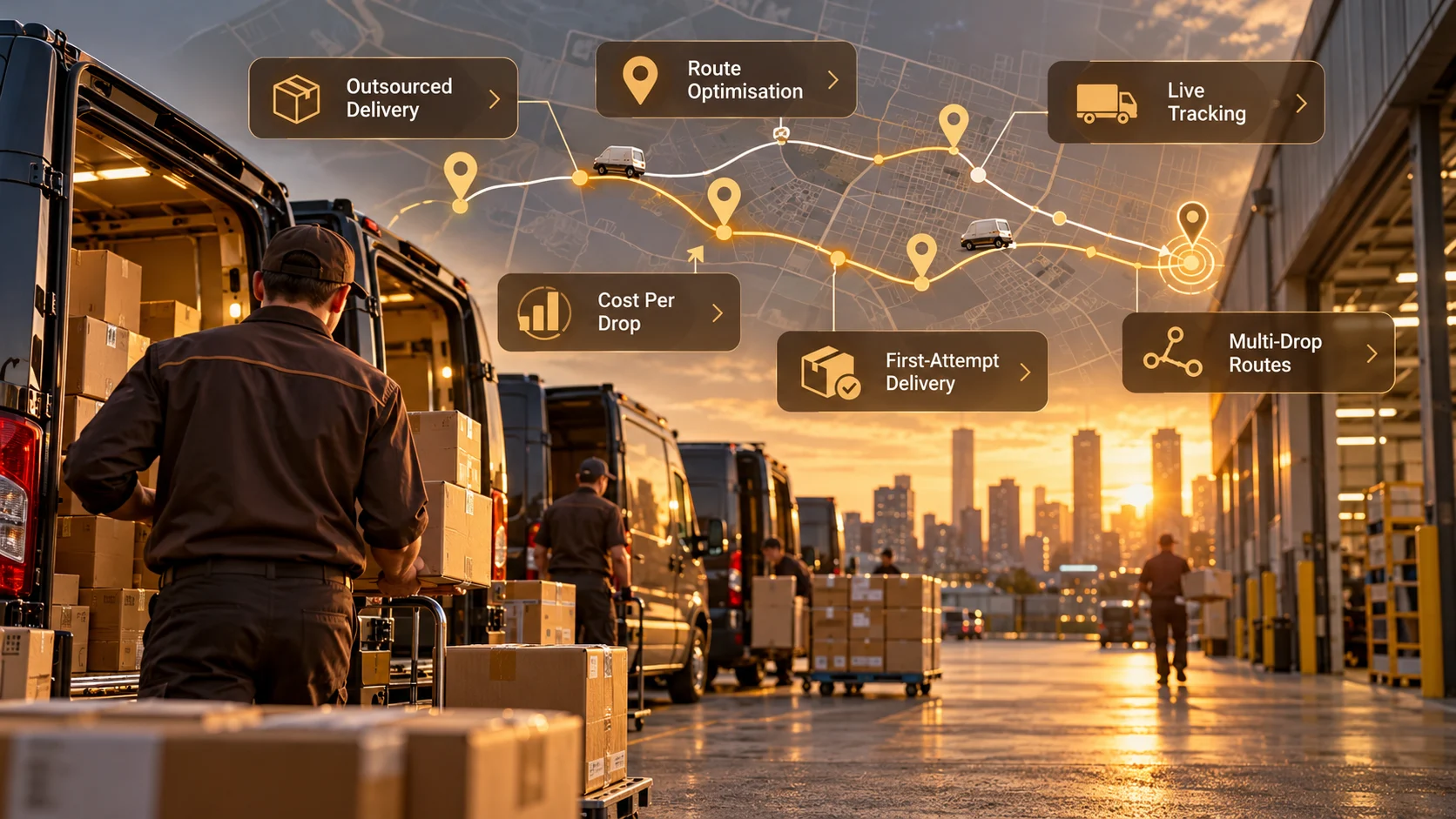
What Legal Regulations Govern Outsourced Courier Operations in the UK?
UK outsourced courier operations are governed by applicable road transport, insurance, employment, tax, health and safety, and data protection requirements. The legal duties depend on the delivery vehicle, type of goods, contractual structure and working arrangements. A company delivering ordinary parcels in a light commercial van may face different requirements from an operator transporting heavy freight, hazardous goods or temperature-sensitive products. The Driver and Vehicle Standards Agency (DVSA) plays an important role in enforcing roadworthiness and relevant commercial vehicle rules.
How Do Couriers Comply With Goods in Transit Insurance Requirements?
Goods in Transit (GIT) insurance protects against specified loss of or damage to goods during transportation, subject to the policy terms, exclusions and coverage limits. UK courier companies must distinguish goods protection from legally required motor insurance. Motor insurance is compulsory when vehicles are used on public roads. Commercial courier operations also require motor cover appropriate to their actual business use. Goods in Transit insurance is not a universal statutory requirement for every UK courier operation. However, clients, parcel networks and transport contracts frequently require suitable GIT protection. A courier carrying third-party merchandise should review several areas of cover.
| Insurance category | Main purpose | Important distinction |
|---|---|---|
| Motor insurance with appropriate courier use | Covers insured road risks for commercial delivery work | Correct business use must be declared |
| Goods in Transit insurance | Covers specified risks affecting transported goods | Limits, exclusions and conditions vary |
| Public liability insurance | Covers certain third-party injury or property damage claims | Often required under commercial contracts |
| Employers’ liability insurance | Covers qualifying employee injury or illness liabilities | Generally compulsory for employers unless an exemption applies |
Courier providers should also review contractual liability, parcel value limits, theft conditions, unattended vehicle exclusions and claims procedures. Insurance should reflect the goods being transported rather than relying only on a generic description of parcel delivery.
Which Employment Laws Apply to Subcontracted Delivery Drivers?
Subcontracted delivery drivers may be genuinely self-employed, classified as workers or employed under a contract of employment. The correct classification depends on the facts of the working relationship, not simply the wording used in a courier agreement. Relevant factors can include personal service obligations, contractual control, financial risk, the ability to accept other work and the degree of independence in operating the business. An owner-driver who operates an independent transport business may have different legal and tax responsibilities from a driver employed directly by a courier company. IR35 and off-payroll working IR35 legislation concerns certain engagements where individuals provide services through intermediaries, commonly personal service companies. It does not automatically apply to every self-employed courier or independent owner-driver. Where the legislation applies, responsibility for determining employment status for tax purposes can depend on the client and intermediary arrangements. Employment rights and tax status also require separate examination. Working hours and driving limits Courier businesses must identify which working-time and drivers’ hours rules apply to each operation. The rules can vary according to vehicle weight, domestic or international journeys, employment status and relevant exemptions. Many light commercial vehicles operating in Great Britain fall under domestic drivers’ hours provisions rather than the assimilated rules that apply to specified heavier vehicles. Northern Ireland has separate requirements in certain circumstances. A delivery schedule must account for applicable driving limits, rest periods, workplace obligations and safe vehicle operation. Data protection Courier companies also handle recipient addresses, delivery instructions, driver location data and electronic signatures. The Information Commissioner’s Office provides detailed guidance on worker monitoring and vehicle tracking obligations. Businesses should document their lawful processing arrangements, restrict unnecessary access and explain the purpose of location monitoring. Compliance affects how courier networks schedule drivers, allocate vehicles, store evidence and measure performance.
How Do Organisations Measure Outsourced Delivery Performance?
Businesses evaluate outsourced courier performance through delivery reliability, service costs, customer experience and adherence to contractual service levels. Key Performance Indicators (KPIs) allow retailers to compare agreed service requirements against recorded delivery outcomes. A strong reporting system measures both individual route performance and the overall courier partnership.
| KPI | Calculation or measurement | What it indicates |
|---|---|---|
| First-Attempt Delivery Rate (FADR) | Successful first-attempt deliveries ÷ eligible consignments attempted × 100 | Initial delivery success |
| Cost Per Drop | Total defined delivery operating cost ÷ completed delivery stops | Cost efficiency per completed stop |
| On-Time In-Full (OTIF) | Qualifying complete deliveries received on time ÷ eligible orders × 100 | Delivery performance against commitments |
| Route Completion Rate | Completed assigned stops ÷ planned assigned stops × 100 | Route execution |
| Fleet Utilisation | Actual productive use compared with defined available capacity | Use of vehicle resources |
| Delivery Exception Rate | Consignments with defined exceptions ÷ eligible consignments × 100 | Frequency of delivery problems |
The definitions must remain consistent across reporting periods. A parcel delivery network counting consignments will produce different results from a business measuring addresses or individual orders.
What Is the First-Attempt Delivery Rate (FADR)?
First-Attempt Delivery Rate measures the proportion of eligible consignments successfully delivered during the first recorded delivery attempt. A successful first attempt might involve handing a parcel to the recipient or completing an authorised alternative delivery arrangement. The exact definition should be agreed between the retailer and courier provider. Illustrative calculation A courier attempts 200 eligible parcel deliveries during a reporting period. Of those, 184 succeed during the first attempt. FADR = (184 ÷ 200) × 100 = 92% This is a hypothetical calculation, not an industry benchmark. A low FADR can indicate address inaccuracies, poor route timing, recipient absence, access restrictions or communication failures. Improving the metric requires examining delivery exceptions rather than attributing every failure to driver performance.
How Does Cost Per Drop Indicate Route Efficiency?
Cost Per Drop measures the average operational cost associated with completing a defined delivery stop. For a route-level analysis: Cost Per Drop = Total Route Operating Costs ÷ Completed Delivery Stops Consider a hypothetical route with:
- Driver and associated labour costs: £120
- Fuel and vehicle costs: £45
- Allocated dispatch and administrative costs: £35
- Completed delivery stops: 100
Total operating cost: £200 Cost Per Drop: £2.00 This illustration excludes any costs not already included in the stated categories and is not a market price estimate. A courier might reduce Cost Per Drop by increasing delivery density, improving loading procedures or avoiding unnecessary mileage. However, a lower cost is not automatically evidence of better service. A route containing accessible residential properties may produce a lower cost per stop than a rural route involving long travel distances and restricted delivery windows. Cost comparisons should account for delivery geography, parcel characteristics, service commitments and unsuccessful attempts. A broader assessment combines cost efficiency with on-time performance, first-attempt success and customer satisfaction. 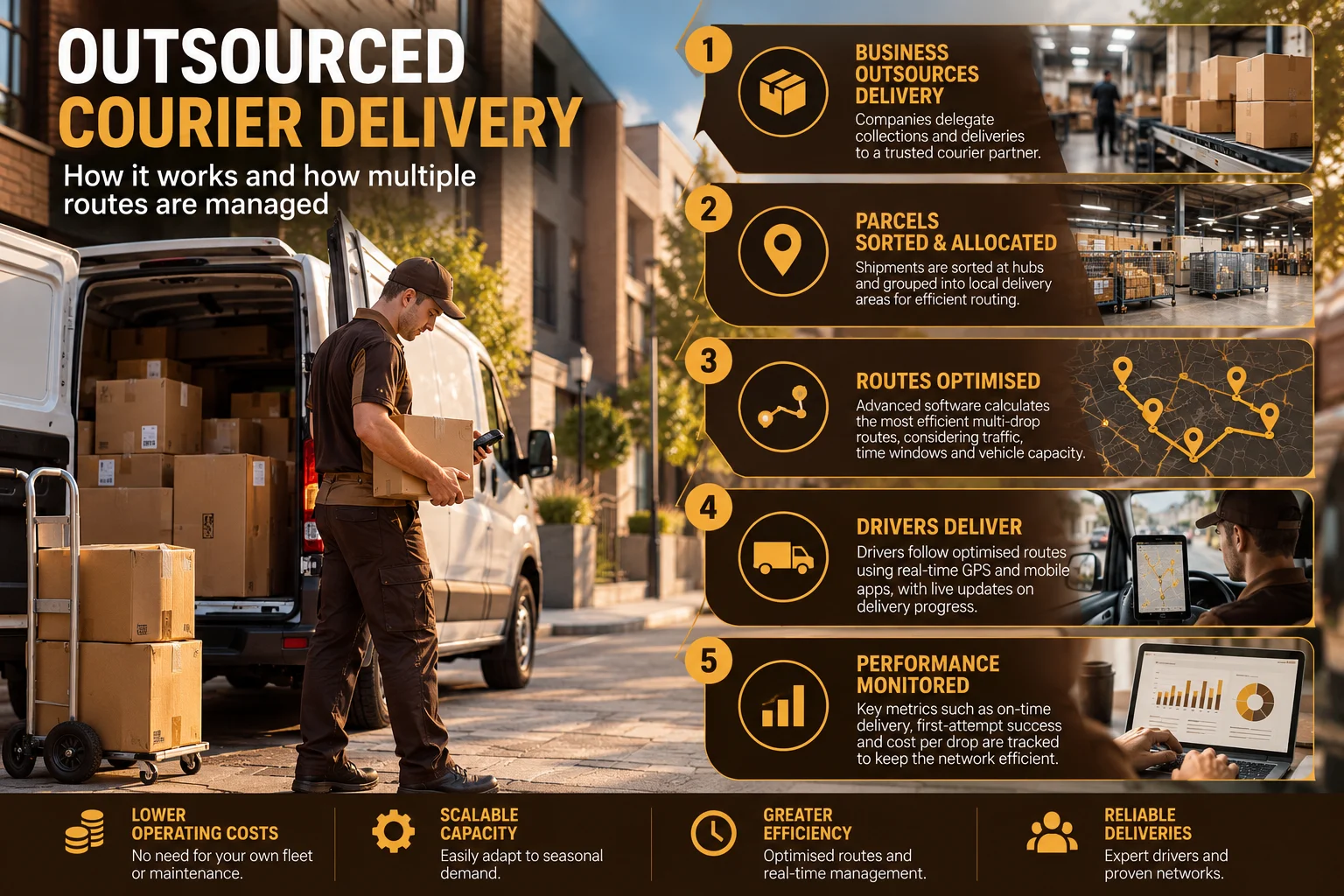
What Are the Main Challenges in Subcontracted Delivery Routing?
The main challenges include failed deliveries, uncertain parcel volumes, limited vehicle capacity, driver availability, inaccurate data and disruption to the road network. Outsourced operations also require coordination between businesses that may use different software platforms, operational procedures and contractual terms. A retailer may expect a specific customer delivery window, while its external provider must accommodate that request alongside commitments to other clients. Courier companies need practical procedures for identifying delivery exceptions, communicating changes and allocating contingency resources.
How Do Providers Mitigate Last-Mile Delivery Failures?
Courier providers reduce avoidable delivery failures by improving address quality, informing recipients and offering suitable delivery alternatives. Delivery failures can result from incorrect addresses, unavailable recipients, inaccessible properties, damaged consignments or unsuitable delivery windows. Several measures can reduce these problems:
- Predictive delivery notifications: SMS, email or application alerts tell recipients when a parcel is expected.
- Address validation: Accurate postcodes, building details and access instructions reduce location errors.
- Authorised safe places: Suitable delivery instructions permit alternative handover arrangements when the service allows them.
- Parcel lockers and collection points: Recipients can collect eligible parcels without remaining at home.
- Electronic delivery records: Tracking events and ePOD data improve investigations into disputed outcomes.
- Exception management: Dispatch teams identify unsuccessful stops and select suitable next steps.
Not every parcel can be left unattended or delivered to a locker. High-value items, age-restricted goods and shipments requiring identification or a signature may need additional controls. When a delivery fails, the courier company must follow the agreed service policy for reattempting delivery, arranging collection or returning the consignment.
How Does Fleet Capacity Fluctuation Impact Peak Season Deliveries?
Peak trading periods increase pressure on delivery fleets because order volumes can rise faster than available vehicles, drivers and depot processing capacity. Black Friday and Christmas are important planning periods for UK e-commerce and parcel distribution. Courier companies may need additional driver availability, temporary vehicle capacity, longer operating windows and revised parcel allocation procedures. Higher parcel density can improve efficiency within a delivery area, but excessive volumes can create overloaded vehicles, delayed dispatches and unrealistic route schedules. Peak capacity planning should include:
- Forecasting parcel demand by depot and delivery territory.
- Establishing available vehicle and driver capacity.
- Identifying potential subcontractor support.
- Reviewing depot loading and dispatch schedules.
- Modelling delivery volumes against route duration.
- Allocating contingency capacity for breakdowns or absences.
- Monitoring service performance throughout the peak period.
Geographic concentration matters as much as total parcel volume. An additional 100 parcels spread across a compact urban route creates a different workload from 100 deliveries spread across rural towns and isolated properties. Courier operators must examine stop density, access time, parcel dimensions and vehicle loading efficiency before assigning additional consignments. These recurring operational challenges have increased interest in predictive forecasting and automated route management.
How Will Emerging Technologies Influence the Future of Courier Outsourcing?
Artificial intelligence, machine learning, predictive analytics and selected autonomous delivery systems could change how courier companies forecast demand, allocate capacity and manage delivery exceptions. The most practical opportunities involve using operational data to support earlier decisions. Technology does not replace the need for safe working practices, commercial judgement or appropriate human supervision.
How Can Predictive Analytics Prevent Delivery Delays?
Predictive analytics uses historical and current information to estimate future delivery conditions. Machine learning models can analyse previous route durations, traffic patterns, seasonal demand, delivery locations and recorded service outcomes. These models may identify recurring delays associated with certain roads, delivery periods or customer locations. The underlying process involves collecting operational data, training a predictive model, evaluating its accuracy and applying forecasts to dispatch decisions. Potential applications include:
- Predicting demand by postcode or delivery zone.
- Estimating route completion times.
- Identifying delivery locations associated with repeated failures.
- Forecasting driver and vehicle requirements.
- Estimating the probability of missed delivery windows.
- Detecting unusual operating patterns that warrant dispatcher attention.
Predictions are not guarantees. Unexpected accidents, severe weather, incomplete information and changes in customer behaviour can reduce forecast accuracy. Courier businesses should measure predictions against actual outcomes and maintain procedures for correcting poor forecasts.
Will Autonomous Vehicles Redefine Last-Mile Delivery Routes?
Autonomous delivery vehicles, pavement robots and drones may support selected last-mile services, but their commercial use depends on technology, operating conditions, infrastructure and regulatory permission. Small autonomous delivery robots can operate in suitable local environments under defined conditions. Drone delivery may support specialised applications where aviation permissions, payload limits, landing arrangements and operating conditions allow. However, these systems face practical restrictions. A conventional courier van can carry varied parcel sizes, travel between distant delivery areas and serve recipients at different types of premises. Small robotic delivery systems generally have more limited carrying capacity, operating range and access capabilities. Autonomous vehicles also require safety management, remote oversight, maintenance and effective arrangements for delivering goods to recipients. For many outsourced courier operations, technology is more likely to assist human-managed delivery networks than replace every driver. The immediate commercial value lies in combining route planning, reliable tracking, predictive capacity management and accurate delivery information. The success of outsourced courier delivery depends on how effectively a provider coordinates people, vehicles, parcel flows and customer commitments across its delivery network. Businesses evaluating an outsourced courier arrangement should examine operational capacity, route management practices, transparent pricing, insurance, delivery reporting and the provider’s ability to respond when planned deliveries do not proceed as expected. Related topics for further reading include courier route planning software, last-mile delivery management, multi-drop driver operations and the costs of operating an in-house delivery fleet. 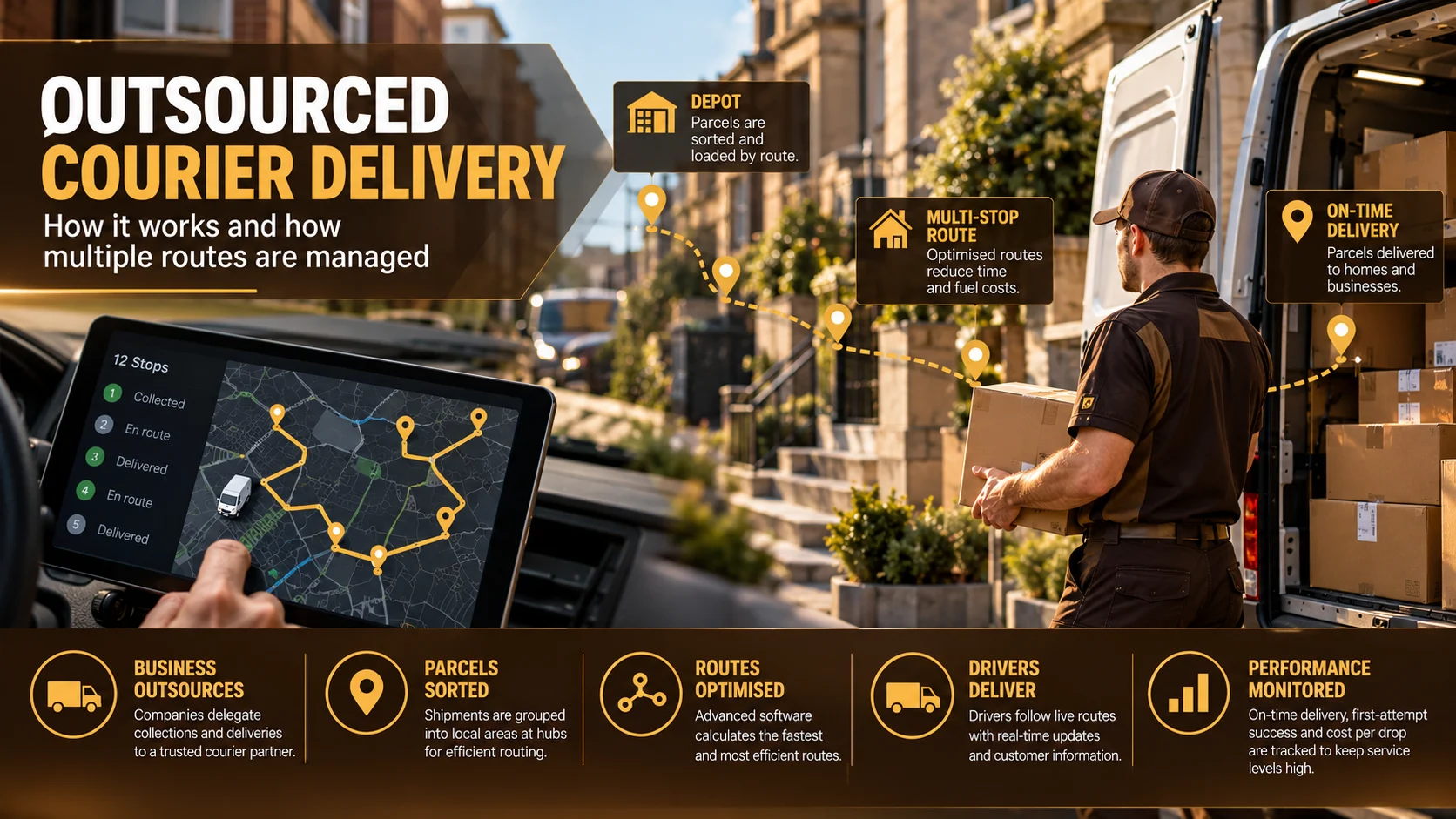
Frequently Asked Questions
Is Outsourced Courier Delivery the Same as Third-Party Logistics?
Outsourced courier delivery is a specific form of contracted logistics, while third-party logistics can cover a wider range of supply chain services. A business might hire a courier company solely to collect and deliver parcels. A 3PL provider may also manage warehousing, inventory storage, order picking, packing and distribution. Some providers offer both services. The distinction matters because courier delivery contracts usually focus on collection, transit and final delivery. Broader 3PL agreements can involve additional inventory management, fulfilment and storage responsibilities.
Can Small Businesses Outsource Courier Delivery Without Their Own Fleet?
Yes. Small businesses can contract courier providers without purchasing delivery vehicles or directly employing drivers. A retailer may use an external courier for individual collections, scheduled local deliveries or recurring distribution work. The provider’s pricing structure may include per-parcel charges, distance-based fees, minimum collection charges or agreed contract rates. Before selecting a service, businesses should compare delivery coverage, tracking availability, insurance arrangements, collection deadlines and procedures for unsuccessful deliveries. The commercial advantage depends on order volume, location, service frequency and the cost of alternative delivery arrangements.
What Is the Difference Between Multi-Drop and Same-Day Delivery?
Multi-drop delivery describes a route involving several collection or delivery stops. Same-day delivery describes a service commitment in which a consignment is delivered on the day specified by the service. A multi-drop route can operate within a same-day network, but the two terms describe different characteristics. One concerns the number and sequence of stops. The other concerns the required delivery timeframe. A dedicated same-day courier may complete a direct point-to-point journey, while a scheduled multi-drop driver serves many customers within an allocated area.
How Many Deliveries Can a Courier Driver Complete Daily?
The number of deliveries a driver can complete depends on route geography, parcel volume, property access, delivery density, vehicle capacity, driving conditions and applicable working-time rules. Urban routes with closely spaced addresses may allow more stops than routes covering remote rural locations. Business deliveries can also require additional handling time, recipient verification or scheduled arrival windows. A reliable daily capacity estimate should use actual route records rather than a single national average. Courier businesses normally examine completed stops, driving time, delivery exceptions and route duration together when planning realistic workloads.
How Should Businesses Choose an Outsourced Courier Provider?
Businesses should select a courier provider based on service suitability, geographic coverage, operational capacity, liability arrangements, delivery visibility and contract terms. A useful assessment begins with the type of goods being transported, expected consignment volumes, collection frequency and delivery deadlines. The business should then examine tracking functionality, proof-of-delivery records, service reporting, insurance limits, peak-period capacity and processes for handling failed deliveries. Price is important, but it should be evaluated alongside delivery reliability. A provider offering a lower transport charge may create higher overall costs if repeated failures, missing parcels or service disruptions generate additional administrative work.

Martin Smith is an industry expert with more than 30 years’ experience in the parcel delivery and logistics. Martin is considered an industry professional in the UK Courier World.


